June Update
June was so busy. My physical health is excellent, but I am mentally and emotionally exhausted. I feel so drained that it took me an unpleasant amount of effort to organize a vacation (which should happen later this month).
This was perhaps my most significant learning experience. A couple years ago, I learned in a business seminar that taking care of oneself is like taking care of the machinery in a factory. The business owner is part of the means of production. Without investing into one’s well-being, we may not be strong enough to carry out the business, and so there cannot be a business. And there is such a thing as being too late to “maintain the means of production”: sometimes the cost of carrying out the maintenance operation is higher than the amount of capital we have remaining. Even if the means of production still seems to work at that moment, we are virtually already bankrupt.
This sounded abstract when I learned it the first time, but now it’s rather concrete: this is nearly what happened to me last month! I was so focused on keeping my physical health in top condition that I neglected mental and emotional well-being.
The takeaway here is that I should start to plan vacations, ahead of time, before I actually need them. This is a skill I have not learned yet. Add to this that I have money separation anxiety; there is quite some additional self-work to do here before I’m sustainably out of the woods.
❦❦❦
How did I get so tired last month? I think the easiest way to explain it is that I was very serious about five different threads of work simultaneously. And next to those, I had a couple of ancillary happenings that padded my free time and took a toll on my emotional balance.
Being serious about a thread of work means that for that particular topic 1) I had ambitious goals 2) I put the hours towards those goals 3) I was also allocating extra effort to optimization to improve my process while I was working 4) I was letting myself think about the work off-hours.
These serious threads of work were not full time, obviously: five FTEs together wouldn’t fit a reasonable schedule. However, I was not disciplined about allocating reasonable time fractions. Instead, I set my goals with an approximate estimate of how much effort each would cost. In doing so, I made two mistakes. One is that my estimates in some cases were optimistic. The other is that I underestimated how much rest I needed to recover from this amount of context switching.
It would be easy to think that my exhaustion is an indictment of choosing multiple threads of work simultaneously. I do not see it like this yet. Instead, I feel this is a skill I’m currently learning and that I will take lessons from last month to make the next months work better.
For sure, maybe I can also choose just three different threads instead of five. But anything less than two would make me bored—that is something I’ve learned already. And perhaps one of the three threads could be a dedicated continuous project to create joyful rest to balance the other two. We will see.
❦❦❦
The five threads that I dedicated serious attention to:
- my dating life.
- the “startup” project, where I’m currently designing/implementing a custom middleware for my platform/app.
- the city council work, where we were closing the financial year and I was reviewing hundreds of pages of budget reports and allocation proposals.
- my online mentoring group.
- one yearly round of home improvements.
The ancillary activities that padded my schedule included an impromptu weekend trip to Estonia (net positive on my well-being), an unexpected visit to my mom (emotional toll, neutral on physical/mental), and high quality time with several beloved friends (also net positive overall).
In hindsight, when I consider everything I have experienced and achieved last month, I feel pretty proud and satisfied, but I wish that the emotional toll would have been spread across three or four months instead of just one. One lives and learns.
❦❦❦
The first thread of serious work is actually the time I’m investing towards dating.
For context, last year, I had reflected that after enough changes happened, my life path was now more ready to include someone else than it ever was before, and also that I desired it. To anyone asking, I would easily clarify that I am curious to both experience new things, and re-experience old things, together with another person.
On the topic of how to meet romantic partners: in the fall, I had talked to a friend about it and she had advised that she had approached dating like a part-time job, meeting many people one after another, seriously and over the course of multiple years, until a relationship would “stick”. It took her years and innumerable in-person meetings, yet it eventually worked (for her). This is the input that helped me decide, around December 2025, to follow her example and put myself to work, with an open mind and lots of patience.
This is why in June, like the five months before, I had time and attention reserved and dedicated to the new people I was meeting regularly.
However, June was also the six-month mark after the start of this project; a check-in was in order. So I also spent a week of time and effort reflecting back and taking some notes.
In a nutshell, something feels off in my process: although I am very successful in meeting new folk for first dates, even frequently (thanks to the help and support from a friend more skilled than I was in the art of presenting oneself), nearly all of them failed to lead to a second date. With just a few exceptions, the choice to not pursue further was mine. There was no “click” that made me desire to spend more time together.
❦❦❦
I am also starting to talk to friends more openly about this predicament. (Not necessarily to ask for advice—sometimes venting is already enough!) As part of one of these conversations, a person I respect and admire shared with me (paraphrasing):
To me, the first impression you give is someone who is fairly intelligent, analytical and direct. It can easily be perceived as dominant or at least intimidating. However, now that I have learned to know you better, I have also seen you present your more vulnerable side. A soft side that is more focused on feelings, on good connections, attentive to others, who is more self-aware. I wonder how much of this you show when you meet someone new.
Although this conversation happened more than a month ago, I still keep thinking about it. I can indeed admit that my more vulnerable facet (let’s call them “facets”) is not usually visible to newly made acquaintances: as the saying goes, I need to “warm up” to new people. A more accurate description would be that living this facet costs me extra energy, and when something “bad” happens to it (including minor hurt to feelings), it also costs me extra energy to recover. Out of (perceived?) necessity, I have learned to be rather stingy with the occasions where I let this facet show.
❦❦❦
Then, later, another topic came up. I have been rather frequently asked “how I use my free time”. Objectively, my daily routine is rather quiet. (I used “dull” initially, but friends insisted that “dull” has negative connotations, and there’s nothing bad about a quiet life.) I tend to be rather content on average, and keep myself busy with the features of an examined good life, per Voltaire and Epicurus: gardening, walks and talking with friends.
Yet… “quiet” is not the entire truth.
There is snowboarding. That feels important. In the same category, there are other things like mountainbiking, playing trampoline dodgeball, ballroom dancing, as well as more sensual physical occupations in more or less social settings. These are the activities where my brain can switch off entirely; where I can experience pure pleasure and joy and feel the maximum amount of connection with other participants, albeit for a short time.
These activities I do not advertise because I do not practice them regularly. But perhaps I should talk more about them? Even though I do not practice them regularly, I do seek this category out frequently. These activities form a large part of my perceived experience of life, even if they are not a large part of my schedule. This feels quite important?
This is another facet like the other two already identified above. A more intense, “flow-based” experiential facet. Compared to the analytical facet and the empathetic facet identified above which I show very consciously and therefore can talk about readily, this third facet erases my sense of self and thus escapes my language abilities during conversations.
How to integrate these insights in my dating program?
❦❦❦
This line of thinking led me to believe that the method I chose (serial first dates) might be working against the grain. If I look back in time, I see that I have built friendships through repeated contact in low-stake shared contexts, with lots of warm up. Then, for this project, I adopted high-volume serial first dates, “like a part-time job”, a method that is the precise structural opposite: one-shot, high-stakes, evaluative, with strangers, with no repetition, no warm-up, and with maximal exposure of the one facet of my personality (analytical, “intimidating”) that reads worst on first contact and offers minimal room for the other facets that actually make me lovable. Maybe the funnel approach wasn’t the right approach.
This summer, I will lower the priority of this “dating project” and reevaluate my approach.
❦❦❦
On the work front, I had estimated in April that it would take me one or two months to complete a first version of the middleware software for my project. At the end of May, after one month of effort, I felt I was stuck because my design looked like a Rube Goldberg machine and it did not spark joy. Then, after one or two weeks feeling quite dejected and thinking about other things, I came back to it, with the idea to write a postmortem and start working in a new direction. As I was writing my postmortem, I realized there were two or three different points where my implementation was going in the wrong direction in a way that I did not understand before. With that new insight I was able to restart the work and suddenly everything became simpler. Now I am even rather excited about it. That work took another chunk of June away, but hopefully there won’t be much more effort remaining to finish this phase. Overall, this area was an emotional rollercoaster.
Meanwhile, my city council work is still going strong. June is the month where we routinely review the financial documents from the year before and start to set goals for the next year. There were also complex and fierce debates about whether or not we should keep certain programs that cost money and have dubious outcomes. I also invested time to talk to civil servants about the technical goals of our energy transition program and how to ensure that air quality [1] and cooling [2] will properly be taken into account in our collective norms for home insulation. Overall, I would say city council work is not something that feels like a hobby, nor does it infuse me with purpose or a happy mood. It just feels like service: something born out of a sense of duty. Meanwhile, it was the focus it required for the review work that felt like a tax on my mental energy. Thankfully, this work pauses during July and August.
| [1] | I’ve been on a crusade against elevated CO₂ levels for several years now. Incidentally, I found a small enlightening piece on this just a few days ago: The bottleneck might be the air in the room by Mike Bowler. |
| [2] | Practically, it is very hard to convince EU politicians of the public benefits of promoting air conditioning. This is a documented cultural phenomenon, see e.g. The American mind cannot comprehend Europe’s AC aversion (archive link) by Georgia Hennessy. |
Meanwhile, I am also still involved as a mentor in this online community for young adults I mentioned earlier. I estimate that I spend one to three evenings per week looking at conversations there, where people ask questions and share their situation. Then I provide feedback or questions to let them think further. This should be a low effort activity; however, there are a couple of participants who have very difficult situations in their life, where it is very hard to make a difference, and where sometimes I personally feel discouraged from all the obstacles that they encounter. Even if the number of hours is low, this task was an emotional downer overall.
❦❦❦
All this with pretty dreadful weather outdoors.
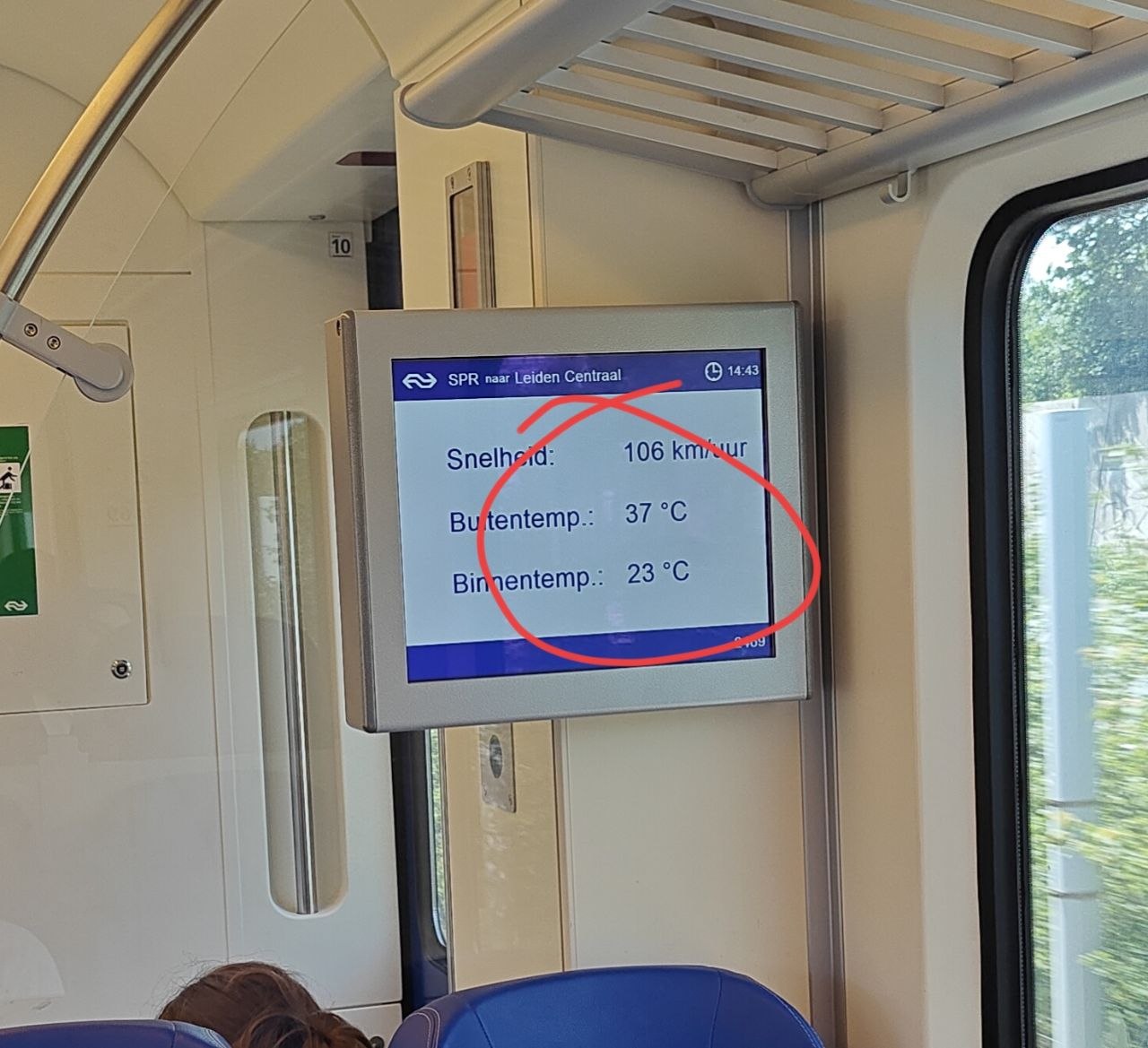
We weathered a heat wave. Some of my workouts were not fully air conditioned, and thus unpleasant and physically and mentally demanding.
❦❦❦
June’s batch of home improvements was sparked at the end of May, when one day I woke up suddenly realizing I had idle unfinished projects, and reminded myself that I had decided earlier I would not be the kind of person who settles in a living space surrounded with unfinished projects.
One task that ballooned out of its allocated schedule was arranging a new bed frame. My previous bed frame was twenty years old and long overdue for a replacement. I tried to be smart and searched for a product that both looked nice and was cheaper. I found one, but then the delivery company lost my package somewhere in transit. I spent between one and three weeks reaching out to different parties to figure out what to do. The package was deemed fully lost so I was refunded, then I bought another product instead that was slightly less nice and slightly more expensive.
I thought initially that the lesson here was to not trust offers that are too good to be true. However, in an unexpected twist, the package was finally delivered! So now I have two bed frames for the price of one. And one of them is in the shape of two inconveniently sized boxes that I now need to find a new owner for. This is yet one more task that requires attention.
❦❦❦
The other home improvement tasks, in contrast, did provide significantly more joy within a much more constrained schedule.
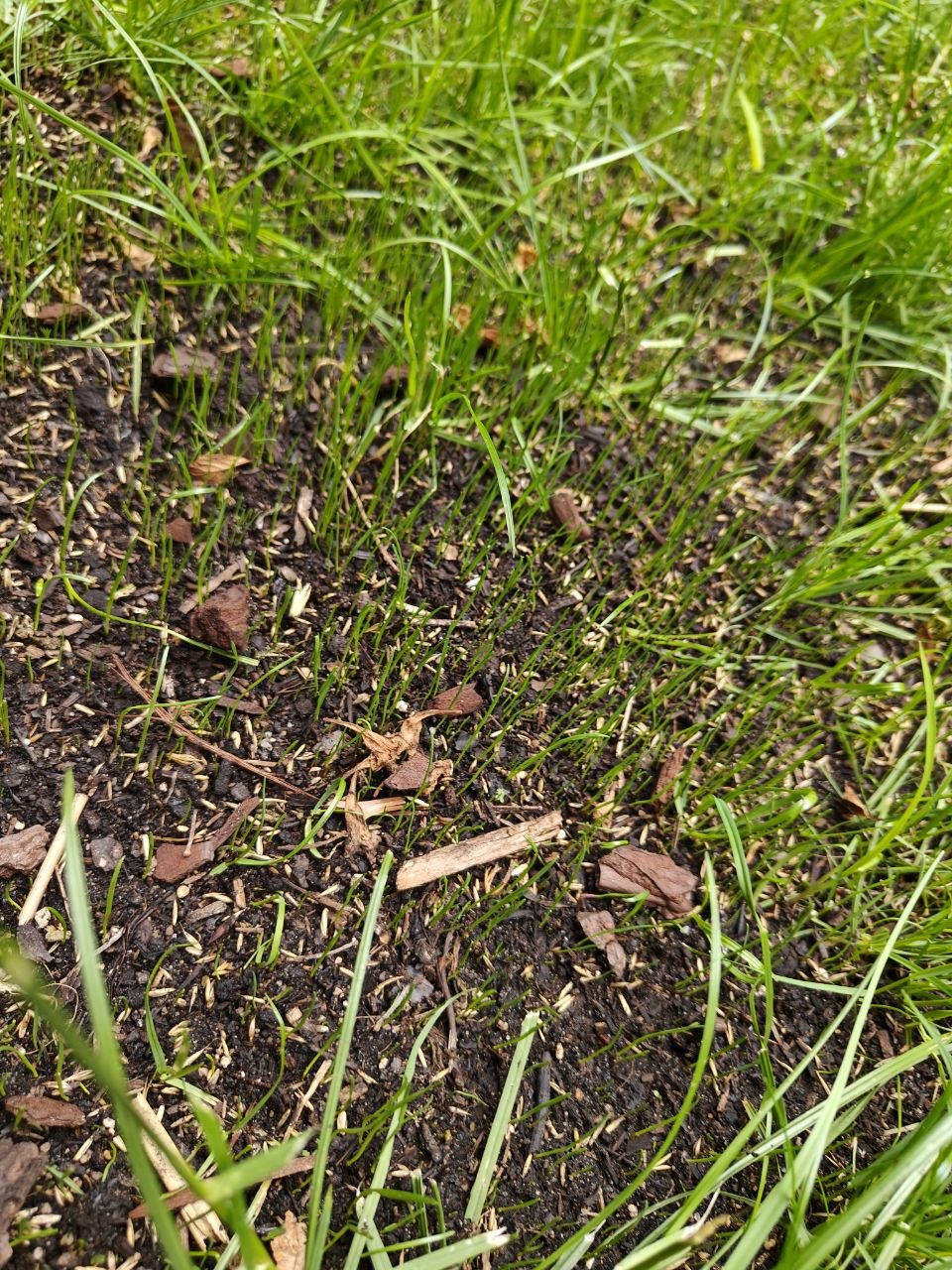
I replanted the grass in my yard at the end of May and was enjoying watching it grow throughout June. It’s not all good yet, so I’m expecting more work on this next month.
❦❦❦
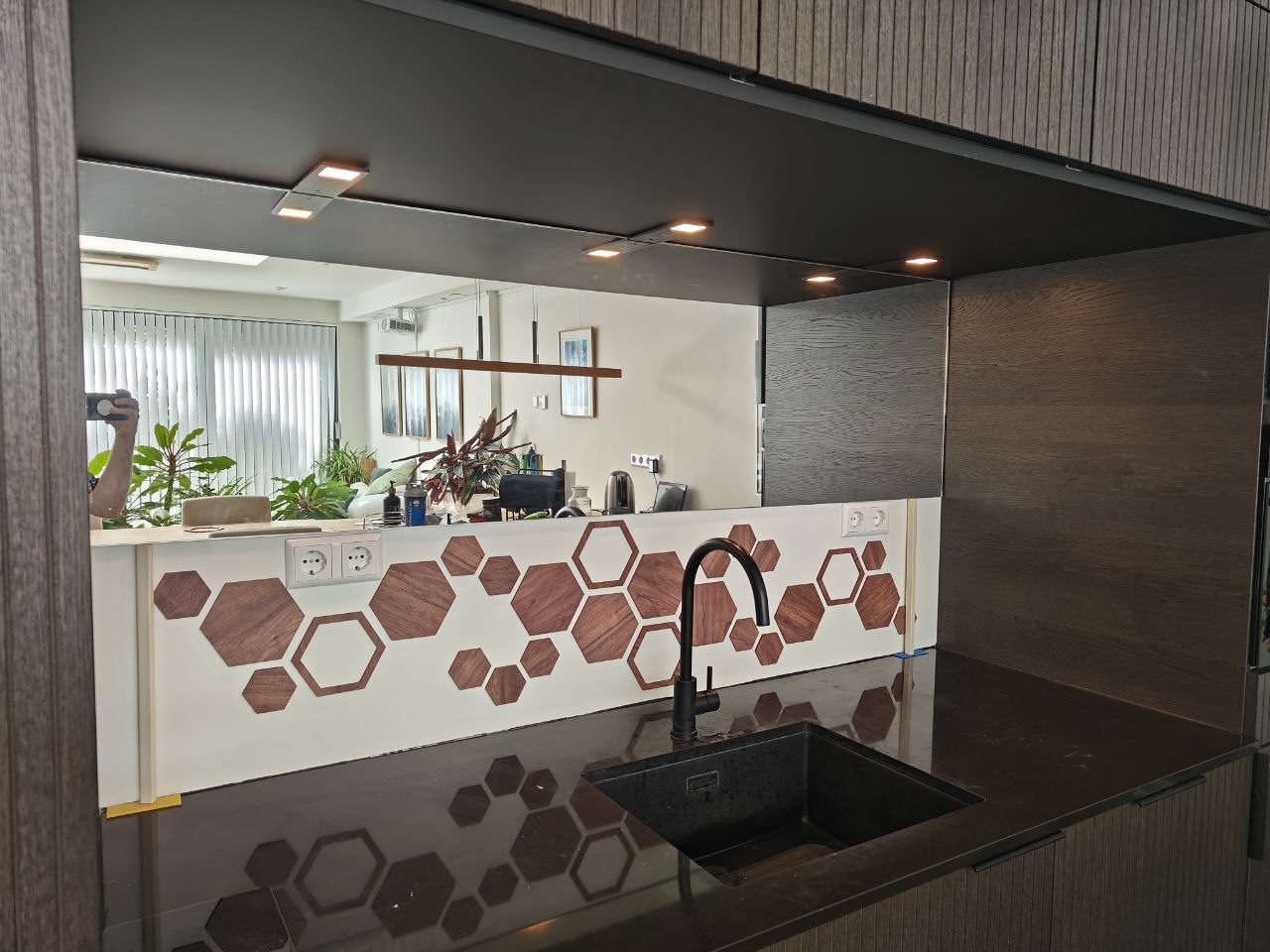
I decorated the back wall of my kitchen with a mirror and some wooden tiles.
❦❦❦
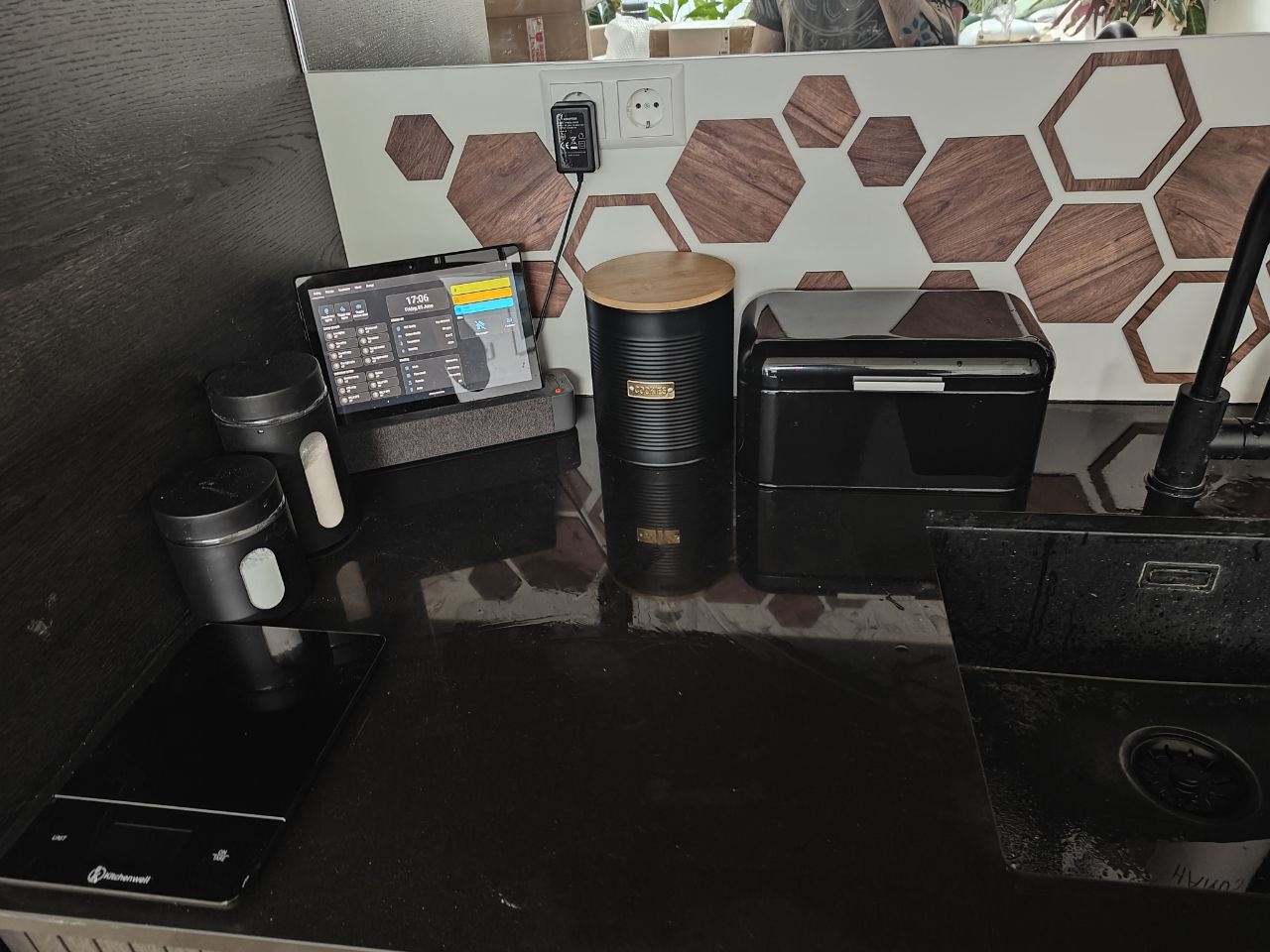
My most frequently used ingredients stay on my kitchen workspace. I used to keep them in their original packaging, which felt visually disordered. I upgraded that by transferring them to visually minimalistic containers.
❦❦❦
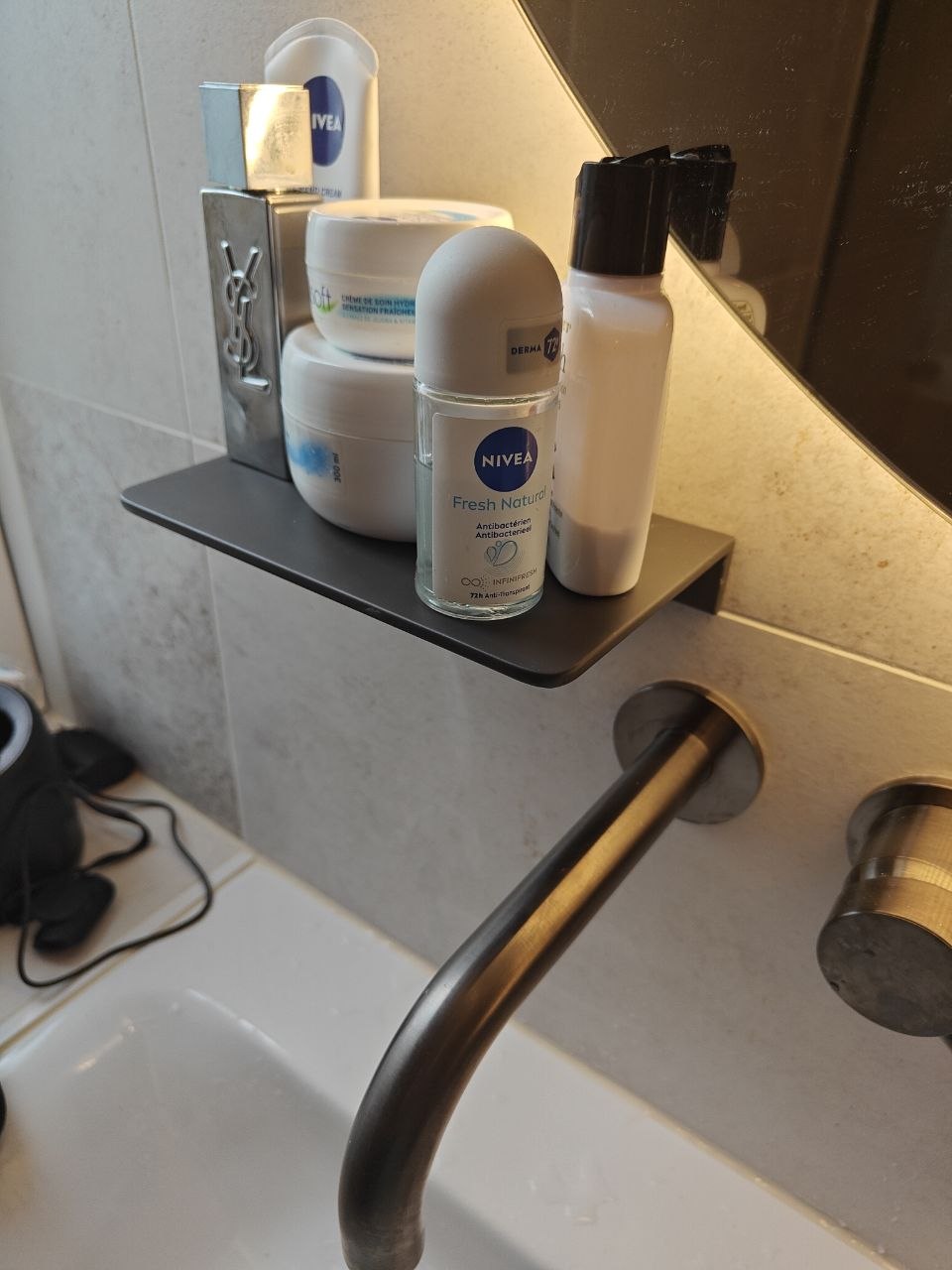
For the last three years, all my bathroom essentials were laying, disorderly, around the sink. I upgraded this by placing two small shelves on the wall.
❦❦❦
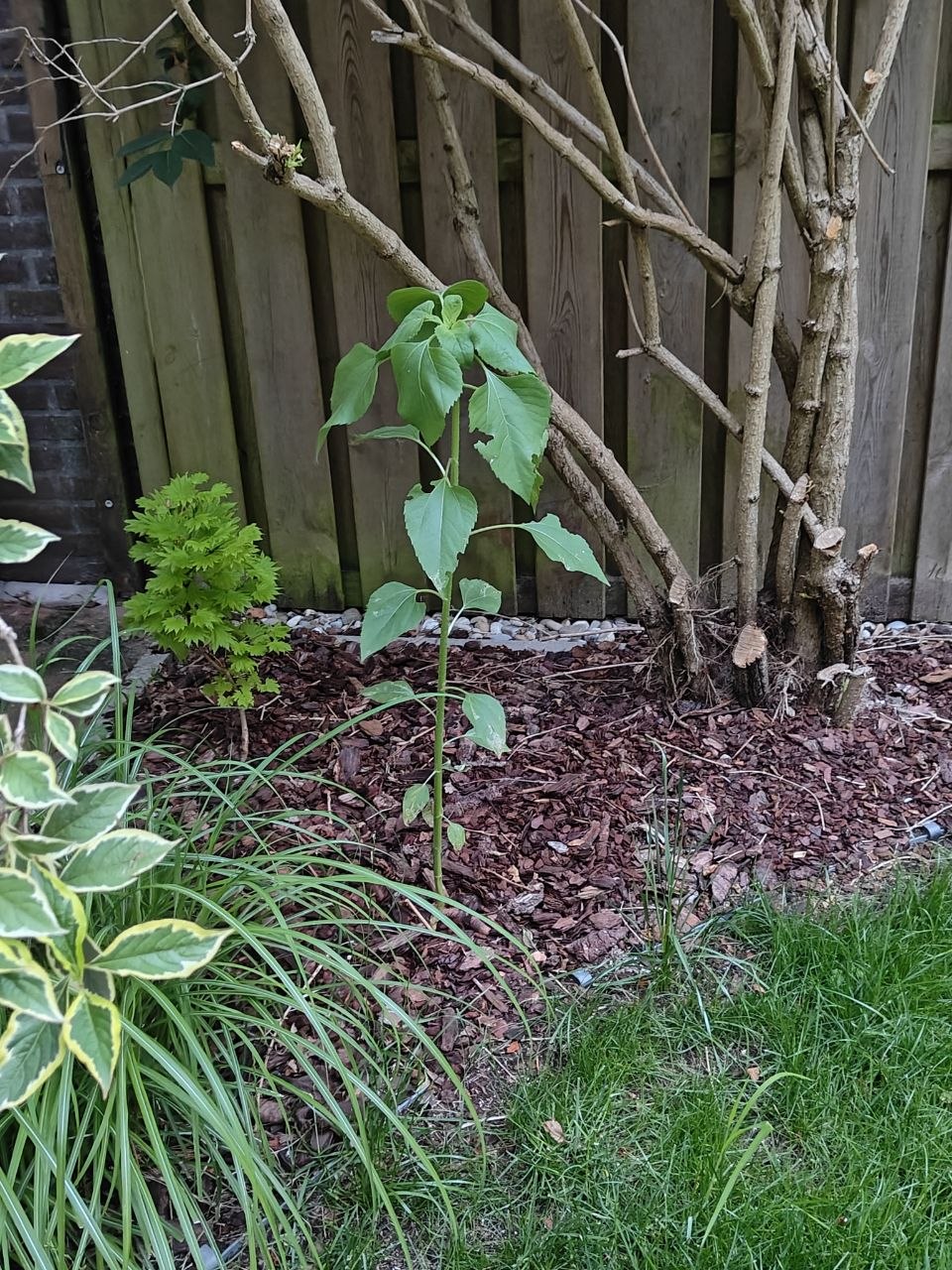
One of my friends gifted me a sunflower plant. We planted it together. Every time I look at it, I am reminded that all our friendships are continuously growing and their bloom may yet be to come. This one sparks joy.
❦❦❦
The most technical home project this time was related to my electricity usage. I wanted to solve two separate problems.
One problem is that my home dashboard was reporting more energy usage during daytime than I could explain. Including on the days where I was not home.
The other problem is that even on sunny days where I am supposed to produce more energy than I consume, my provider is charging me for consumed energy.
Both problems required a common building block: I added additional energy/power usage sensors, to have a better picture of where electricity was used.
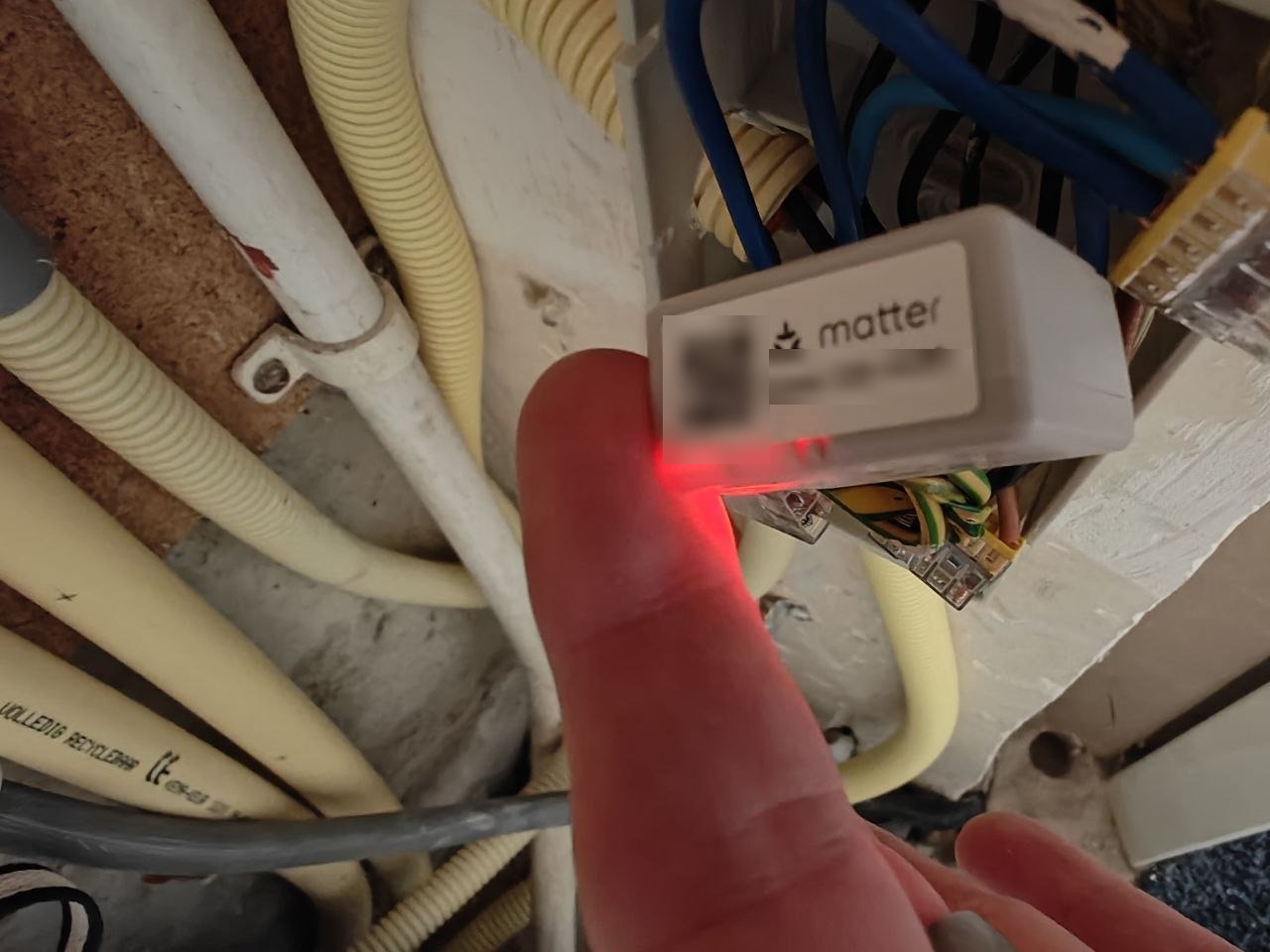
Very satisfied with the Shelly EM Mini Gen4. I use several; they fit well in power distribution boxes.
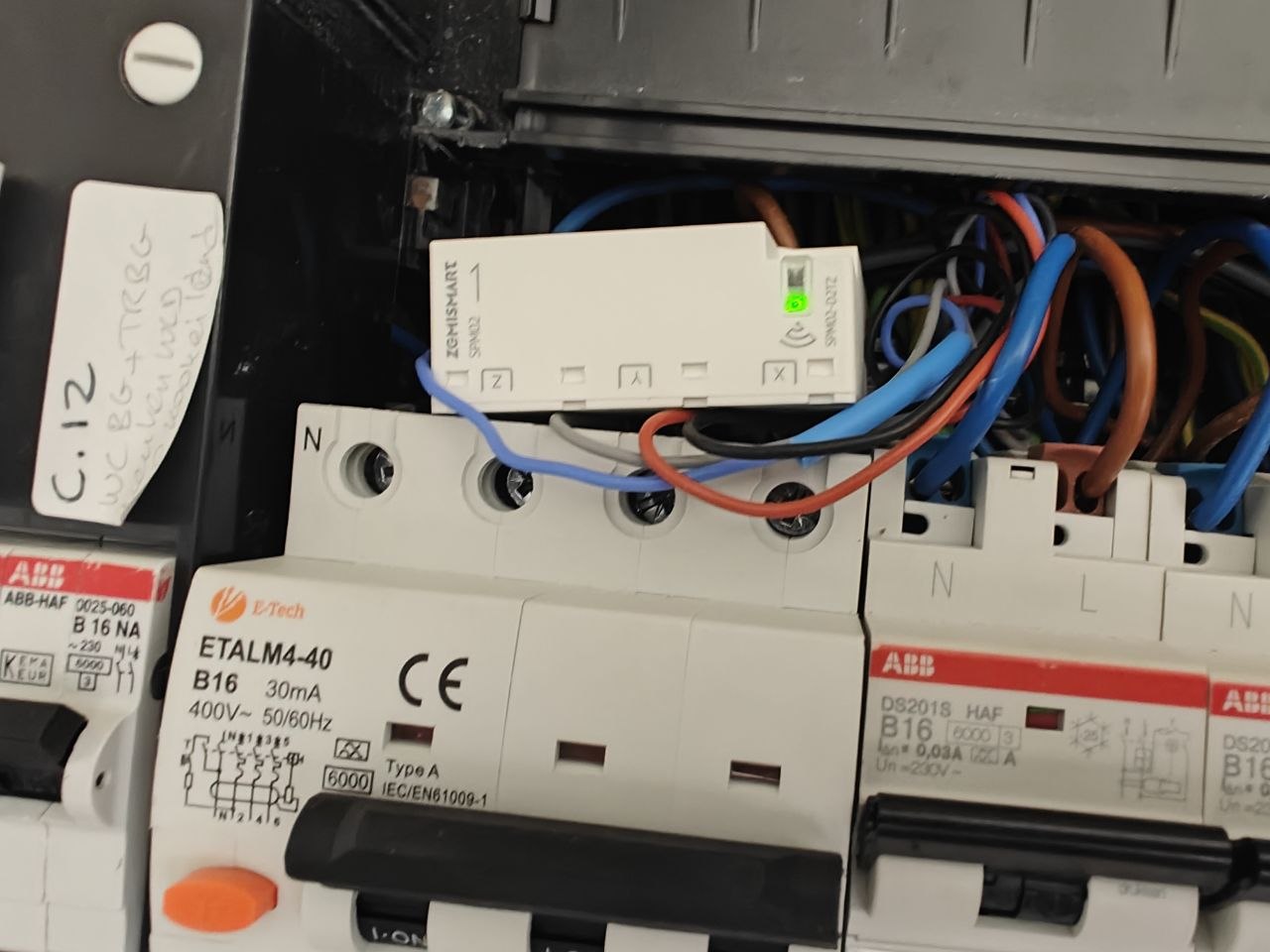
Also somewhat happy with this Zemismart meter. Even though my solar inverters are independent (one per phase) I needed a sensor compact enough, and this mini induction-based three-phase sensor fits my volume budget.
The first finding after adding my own sensors is that the reporting by the solar panel provider’s own app is higher than the actual energy delivered on the wires. I suppose that is a reminder of poor incentive alignment? (Maybe not trust the wolf to report on the well-being of the lamb.)
This discrepancy alone was sufficient to explain the unexpected energy usage during the day. This is because energy usage in my home is computed by subtracting the net grid metering from the solar production. If the solar production says 1000 watts and the grid meter says that 900 watt is being sent to the grid, then subtraction says I have 100 watts of self-usage. In my case, the solar sensor was reporting, in this example, 1100 watts of production (incorrectly). So with the same 900 watts sent to the grid, it appeared as if I had 200 watts of usage inside my home, that is, 100 watts of “ghost”, non-real usage. This also explains why the difference only happened during daytime. With the new sensor I placed myself, there is no unexplained usage anymore. That was solving the first problem.
The other problem is still unclear, but now I have a lead. By default, Home Assistant only provides an aggregate overview of energy produced vs. energy consumed. However, I have a three phased supply. So I created my own dashboard:
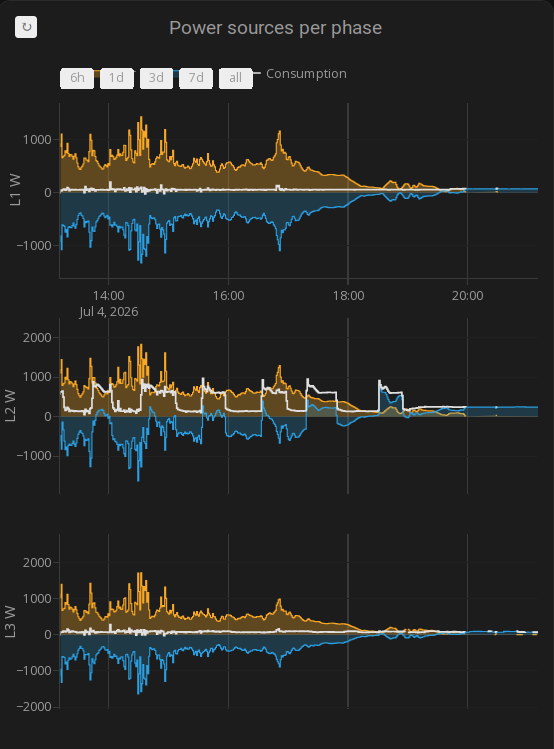
This plot separates power produced, the net grid metering and the derived power consumed, per phase.
What this reveals and which was not visible in the aggregate view is that on phase L2 there are moments where my heat pump is consuming more power than the solar inverter on that phase is producing—even though the aggregate amount of solar power produced at that moment across phases is higher than that device’s consumption. I believe this is the reason why my provider is charging me for consumption: phases probably don’t cancel each other’s usage vs. production for billing purposes.
I probably need to contact the provider to get more details on this. If the theory is correct, that will give me one more argument to arrange a battery, to use as buffer between phases.
❦❦❦
One of the good things that happened in June was that the weather allowed me to start meeting friends outdoors again.
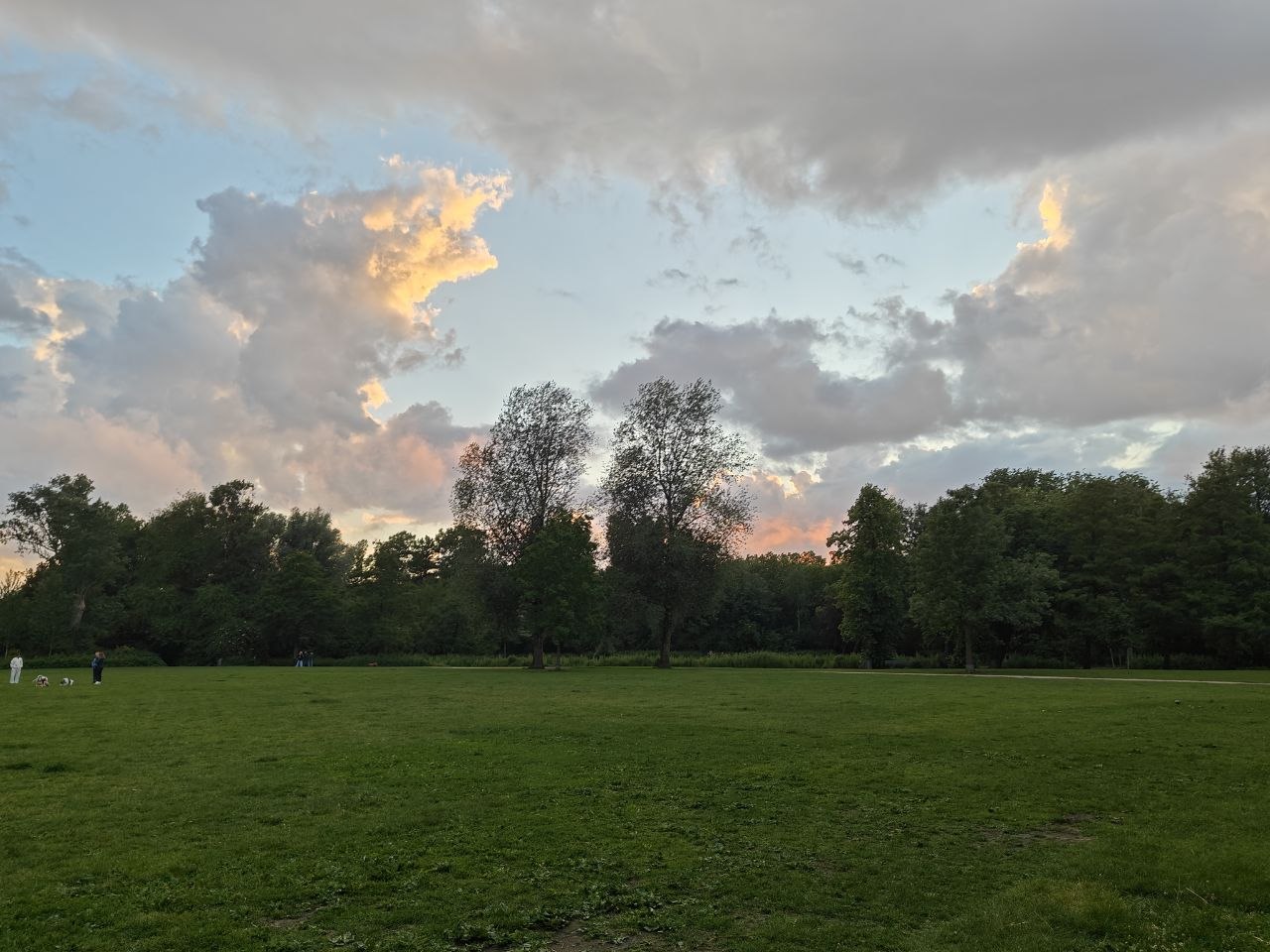
There were quite a few stunning sunsets.
Another good thing is that a friend and I went to visit Tallinn. We had meant to spent some time together for a while; this particular destination was arranged somewhat at the last minute. Serendipitously, it gave me a few days of respite from the heat back home.
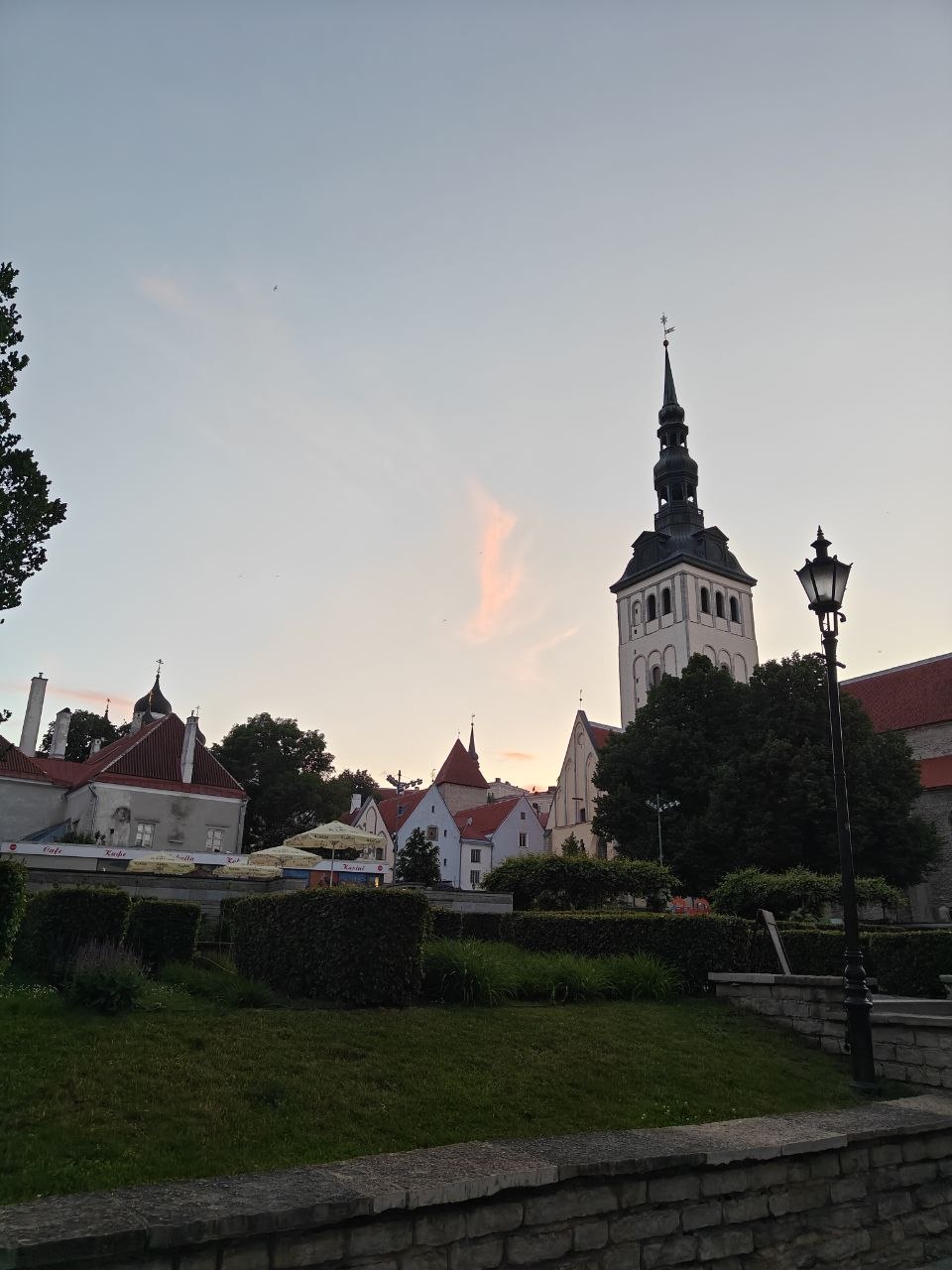
Tallinn’s old town has preserved its medieval architecture. It was very quaint.
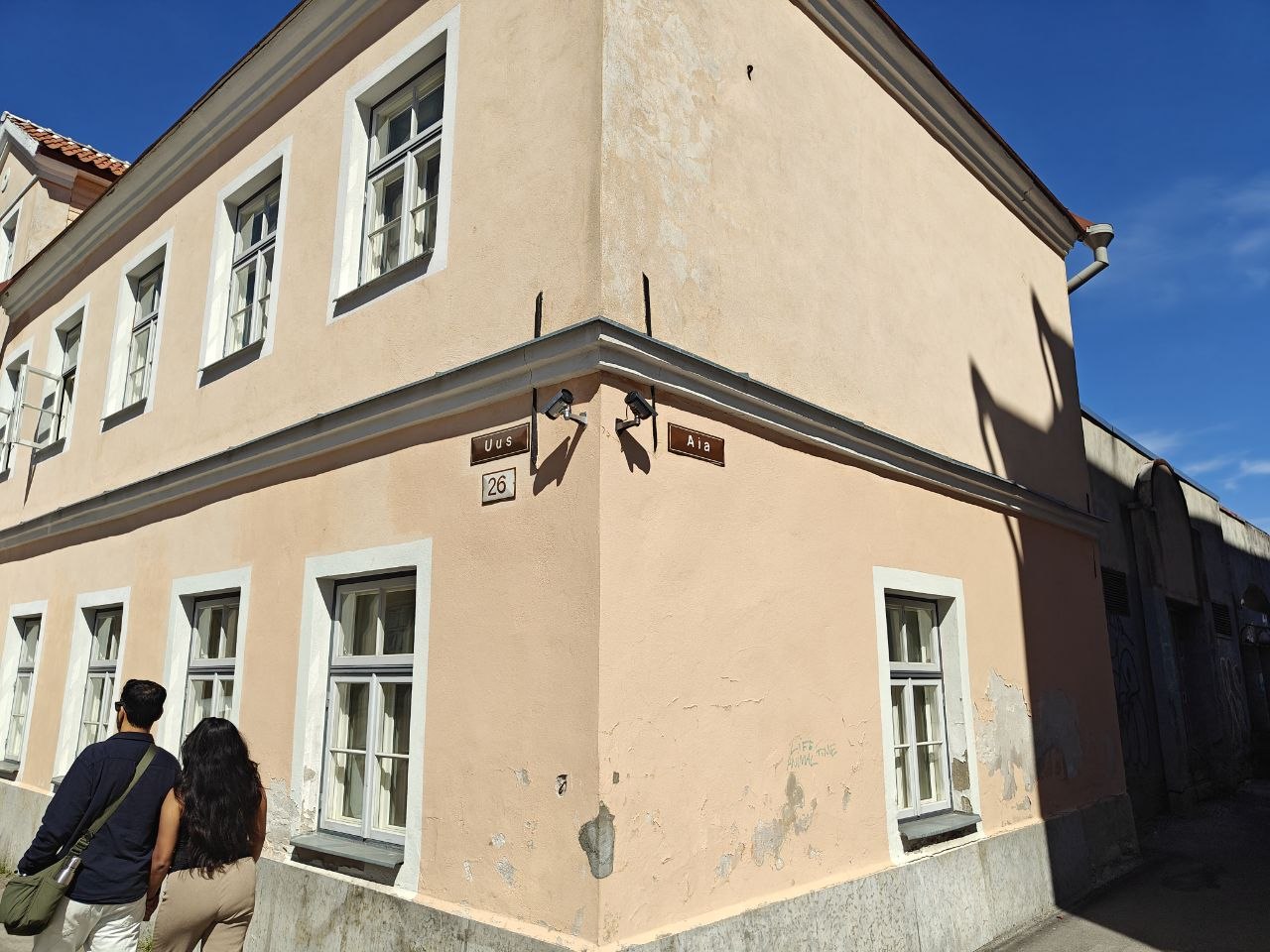
Many of the old street names are very short; probably common names in Estonian. I have no idea what they mean, but the spelling looks cute.
One highlight of our trip was a visit to Fotografiska, a modern art / photography museum.
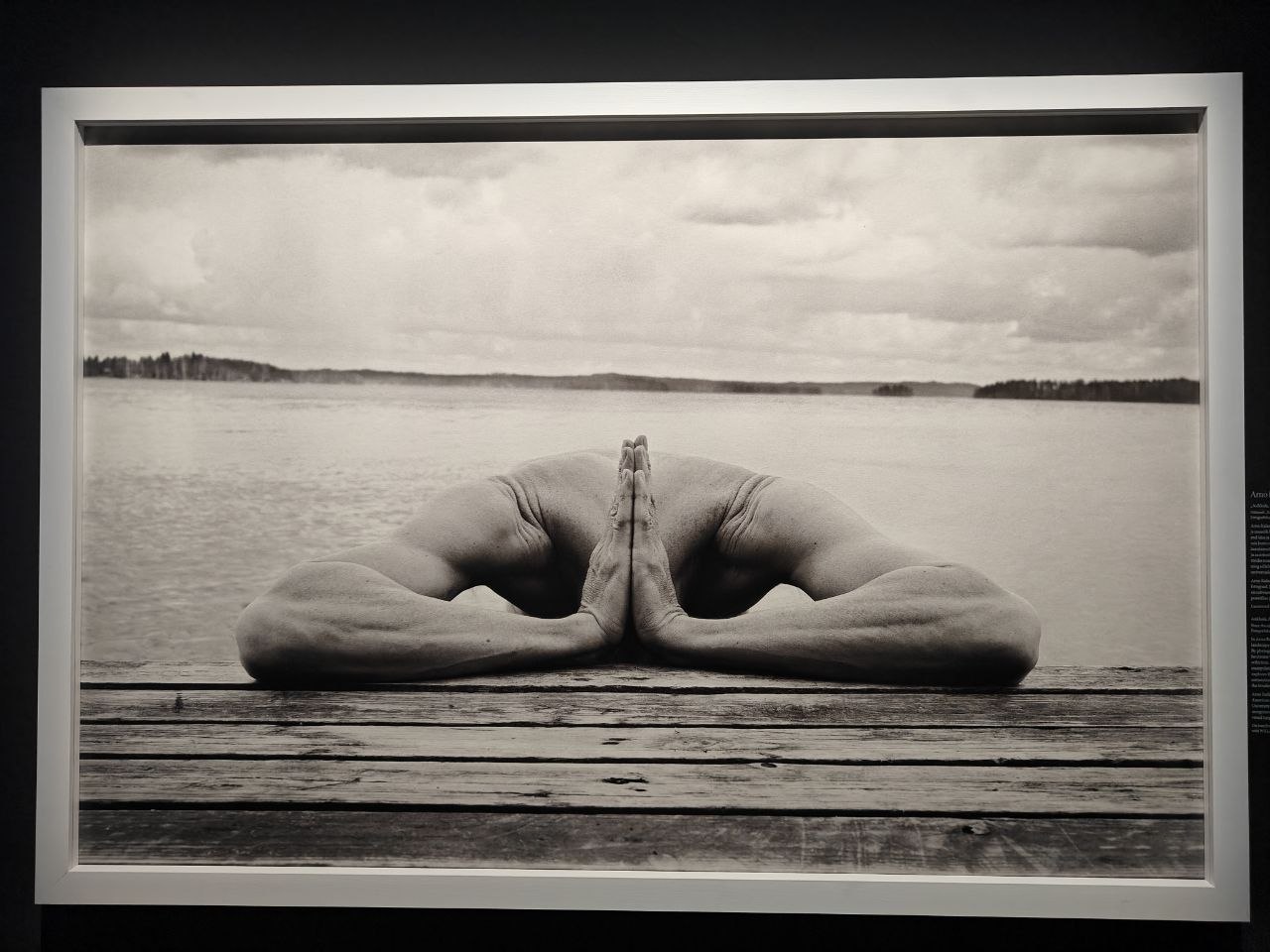
Asikkala, Finland, 1992 - Arno Rafael Minkkinen.
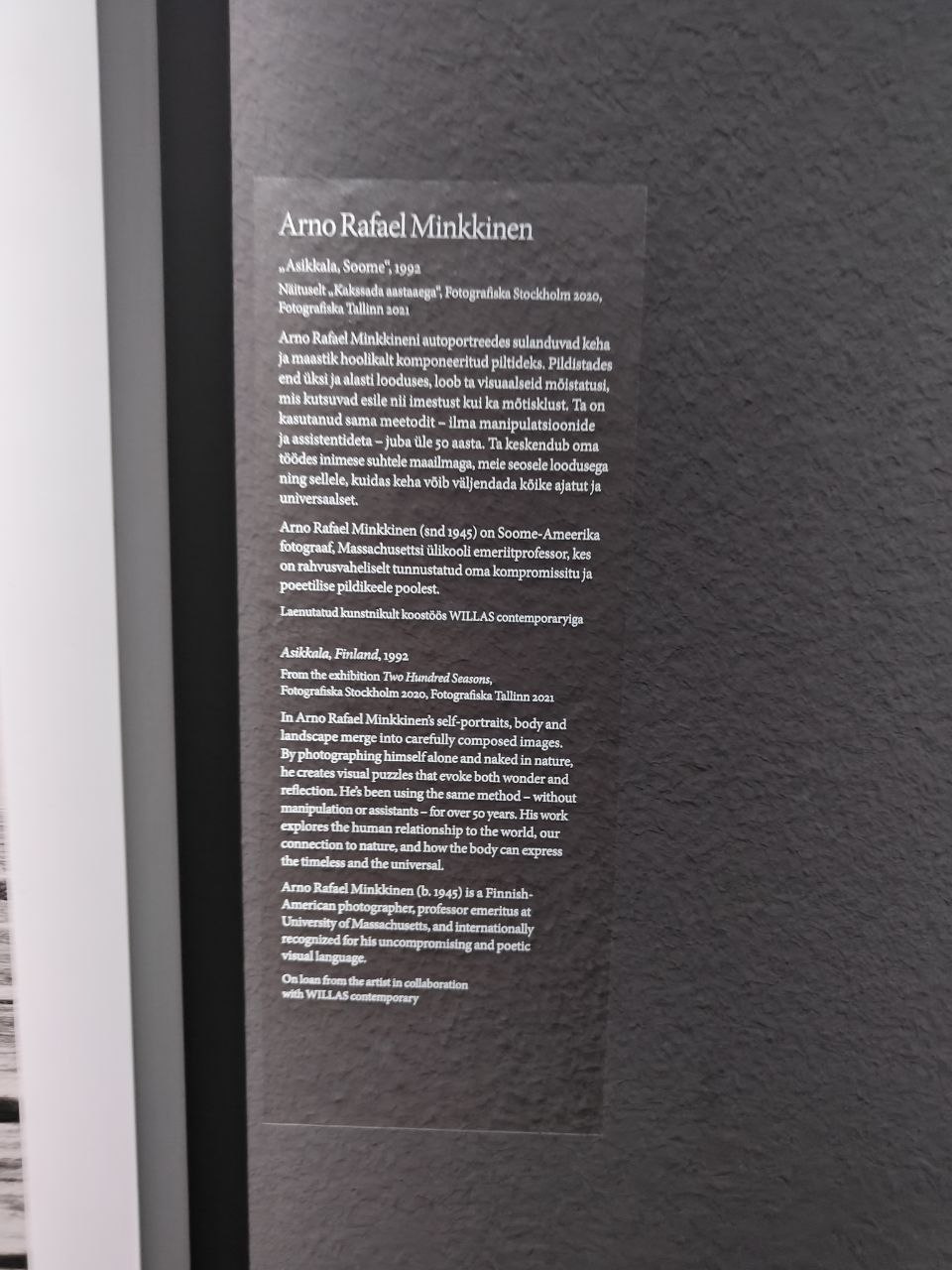
I really liked this picture. I’ll be checking out this photographer’s work.
There was also street art to enjoy.
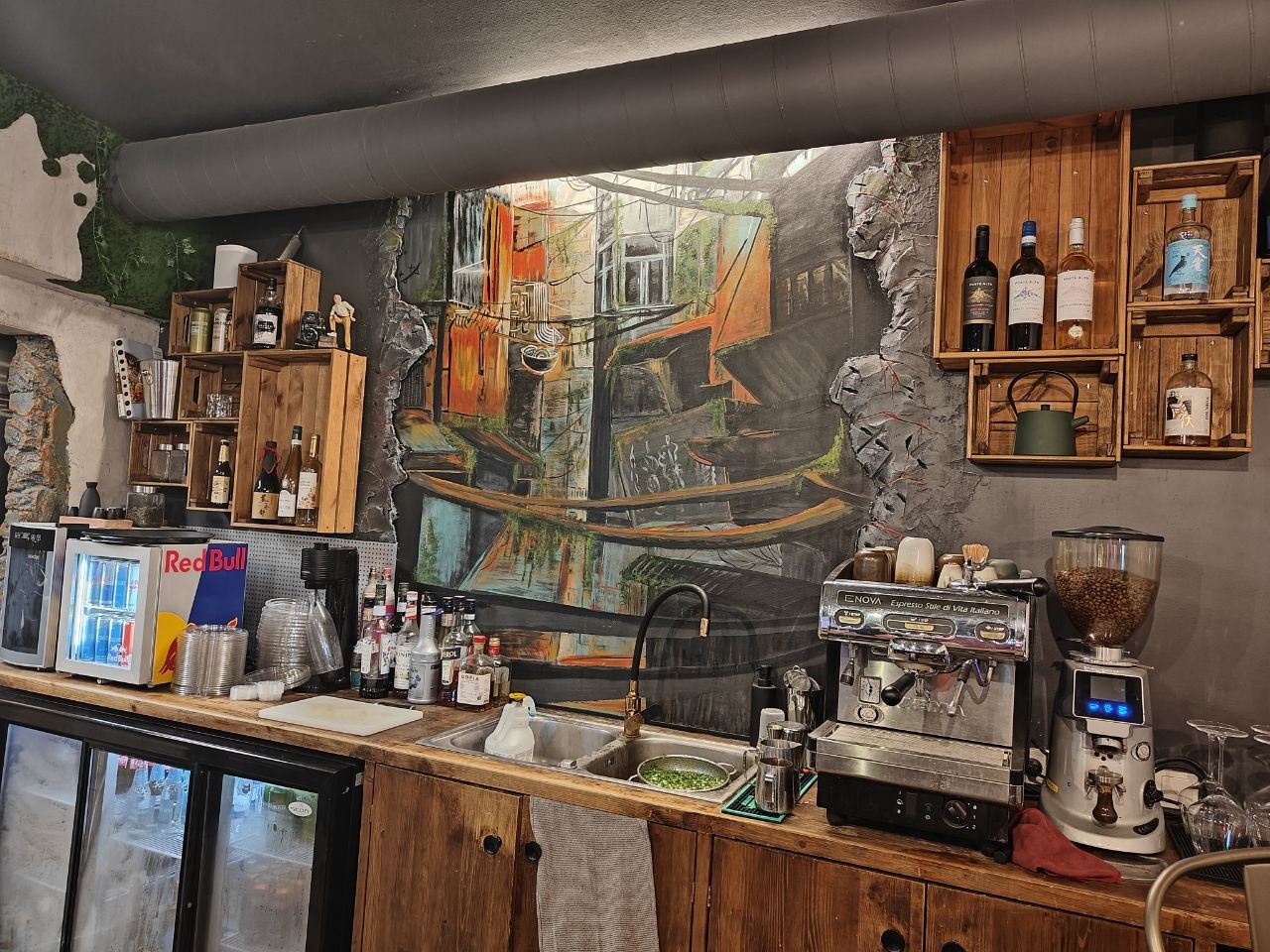
The wall art in this ramen restaurant was stunning.
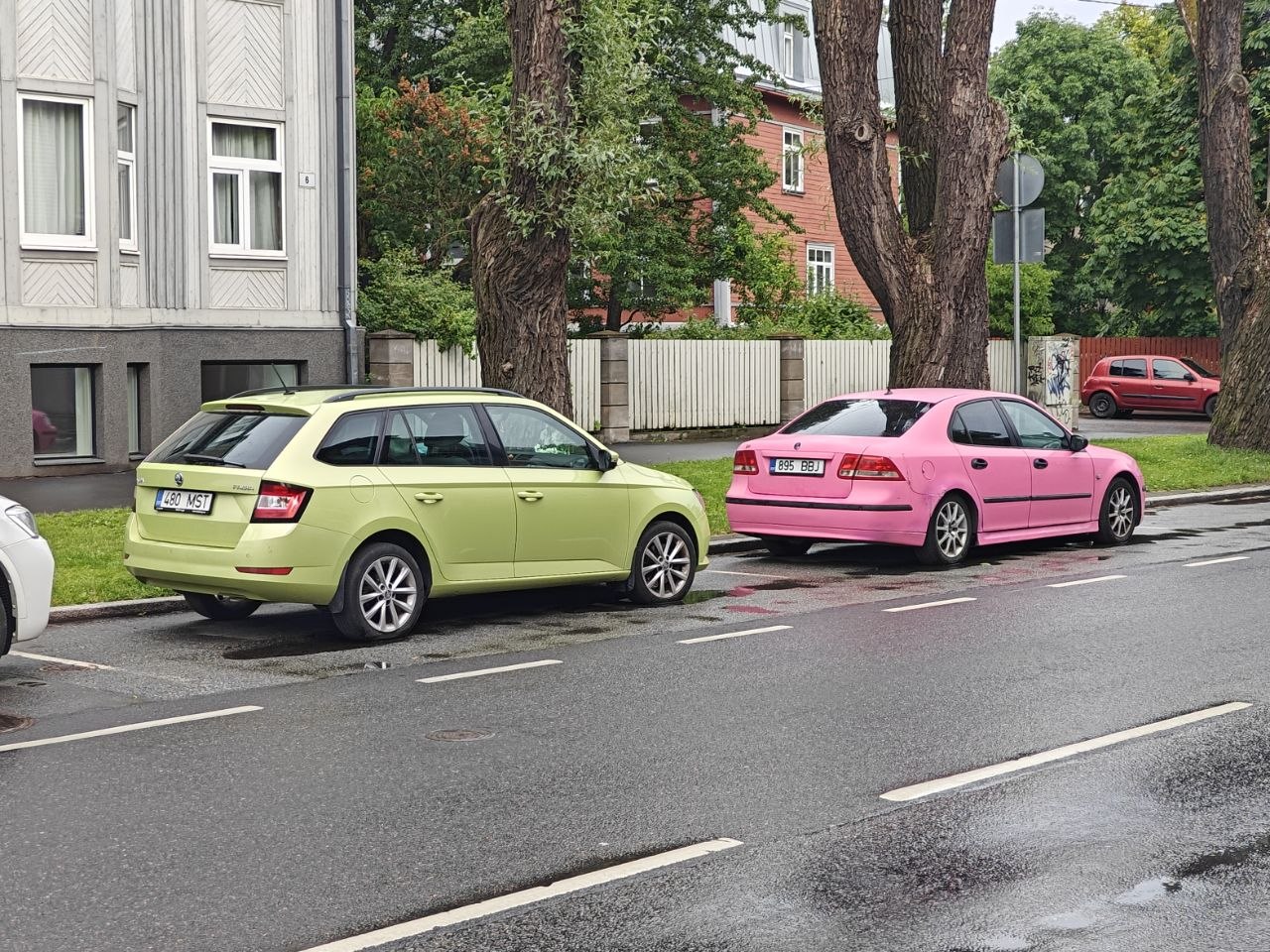
These Skoda cars were custom wrapped/painted by their owners.
❦❦❦
One week later, I went to visit my mom. This was quite the emotional whiplash.
I had originally planned to visit her later this summer, but had to move the trip up in the schedule: a tenant in her house is moving away, we needed someone to do the paperwork, and nobody else was available.
As to my mom herself, the clinic where she is currently staying did good work on her body and her anxiety. She looks somewhat younger and fresher than before. Overall, that is a net positive.
However, blood vessels in her brain will never properly heal, and she is losing neurons at an accelerated rate. Although we can still have small conversations, she is now partially forgetting who I am. Even though I had prepared for this eventuality, it still pinched my heart.
The silver lining is that she does not really remember where and how she lived before and so she mostly stopped feeling the pain of losing her autonomy.
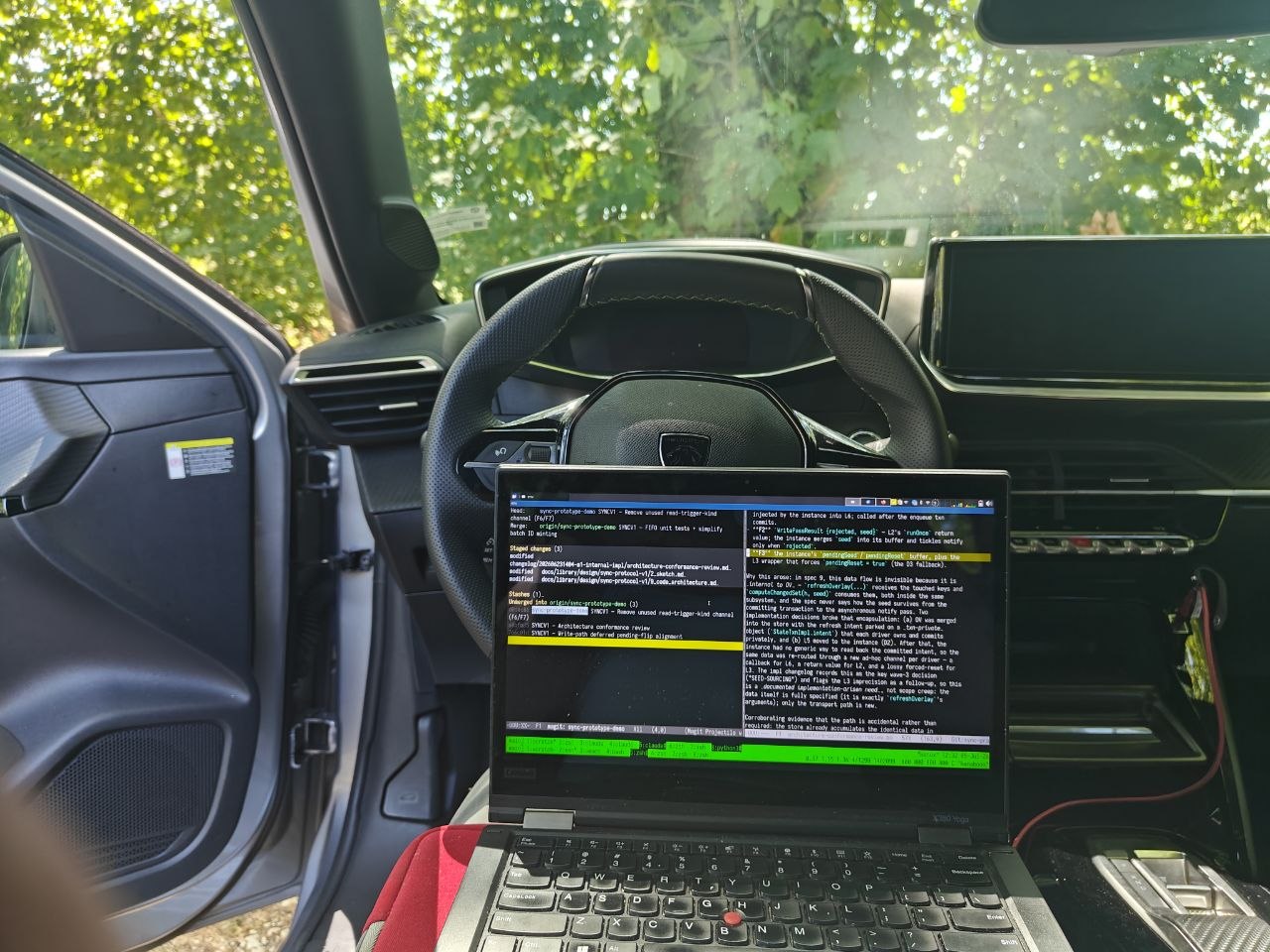
Her current clinic is rather isolated in the countryside and only allows visits from 2pm onwards. I chose to fill my waiting time with “remote work” from the car that I used to drive there.
(Incidentally, I was happy to read that An 80-year-old woman with advanced Alzheimer’s regained speech and mobility after taking psilocybin; even though I understand that psylocin can’t do anything for ruptured blood vessels and so this won’t work for my mom.)
❦❦❦
If you are still reading at this point, maybe now would be a good time to take a break, walk a bit outdoors, breathe deeply and touch some grass. Maybe even have a short chat with a loved one. I did too while writing this.
❦❦❦
Given all that was happening, I only had limited time for reading. Still, I was able to finish a book I started earlier in May.
- Socrates op Sneakers - Elke Wiss
- This was recommended by a young someone whom I am mentoring. In a nutshell, it explains how to use the Socratic method to drive conversations and make them “more interesting.” It is rather well-written and I wish I had access to it when I was a teenager; it would likely have accelerated my learning of social skills at that stage of life. I’ll probably recommend it to any folk between 16 and 25. An English translation is available.
❦❦❦
There was also some time for interstitial reading.
I first started reading Halvar’s Guide to Entrepreneurship by Thomas Dullien as a distraction from another task, and then caught myself reading it with attention. This is an experience report on organizational design; it confirmed my own experiences in some areas (product design, management), so I became curious about what the author had to say in other areas. I’d recommend it! It is not as comprehensive as the High Growth Handbook that I read two years ago, but certainly more compact and approachable.
❦❦❦
In the Netherlands, the months of July and August are called “cucumber times”. That is because real news is thin in summer and so all there is to talk about is cucumbers. Keep this in mind. We’ll come back to it in a second.
Meanwhile, usually, historical story arcs are covered through calendar years. The following arc is best viewed as what happened between summer 2025 and summer 2026:
business owners are induced into executive psychosis by their “smart” chatbots and start making dubious decisions.
Example: Bosses Are Becoming Obsessed With AI, Using It to Make Every Decision, Barraging Their Employees With Nonsensical ChatGPT Directives, and Even Asking It Who to Fire, Maggie Harrison Dupré (Futurism).
(This one would have made me laugh if it was satire—it’s so grotesque! Sadly, it’s all real.)
… some time passes …
It did not work as expected! Oh no! Who would have known?
Ford hired AI and sacked humans. It backfired badly, Anthony Cuthbertson.
Meta’s Zuckerberg says AI agent tech progressing slower than expected, Katie Paul and Courtney Rozen.
experts in the industry start to pile on with “I told you so” retrospectives. This is going to be the cucumbers of summer 2026.
Maybe that summary sounds glib? I don’t know. In any case, I found these following two analyses quite good. If you want to take only one piece of LLM-related news away from this month, take these two.
- Why AI hasn’t replaced software engineers, and won’t by Arvind Narayanan and Sayash Kapoor.
- Talk is Cheap — What the data says about the operational impacts of LLM use in the software industry by Jake (@oudlys)
In hindsight, it looks like I chose the right time in history to start my own bootstrapped project away from corporate madness. 🤷
❦❦❦
Maybe the right move at this stage is to start grounding ourselves again.
One piece that touched my heart is this plea by Jay Acunzo to celebrate lived experiences: The best response to AI slop, infinite advice, and online noise is from Robin Williams. Choice quote:
Right now, the mere idea of “knowing” is winning out, when it’s hilariously insufficient to do anything effective or meaningful or good. The internet and many voices using it would have us convinced that because there’s so much to know and because someone else knows more and because a software tool can tell you things it “knows,” then all of that should cause you to sit down, shut up, stop feeling confident in what you’ve done or seen or felt. Because what’s your life in the face of infinite knowledge?
Turns out, everything.
In a nutshell, the author reminds us of what makes us interested (and interesting) to each other and asks us to do more of that, with or (preferably) without LLM assistance.
❦❦❦
Switching gears and away from LLM news.
One of my teenage years interests was computer vision, and today is as good a day as any to recall that our eyes see more than a screen (or a printer) can display.
In Where to Find the Colors Your Screen Can’t Show You (Ryan Moulton), we learn the math of why the light diffused under the leaves when we walk in a forest is a shade of green that can only be found outdoors. Iridescence and colors on birds and butterflies are unique experiences as well. And, perhaps surprisingly, the green LEDs of traffic lights. Per the author:
I can’t show you these colors, but by telling you about them I can help you notice them. When you notice, you may be astonished to find that they were there all along, and that your screens are duller than you thought they were. When you drive home today and see a green traffic light, notice it. Try to see it as bright and as beautiful as it really is.
Incidentally, What every coder should know about gamma by John Novak is also relevant here.
❦❦❦
Looking at economics, a lot of big and important things are happening in the world in 2026.
Somehow, I feel that a lot of the the big item news can be looked at through the lens of textbooks from the 20th century. However, two things happened in 2026 that really feel new, dangerous and complicated, for which we don’t have any handbook yet: the liberalization of prediction markets and the first steps towards legal integration of cryptocurrencies into the financial system.
The best piece I’ve read on these topics is Crypto in 2026: Oh, This is the Bad Place by Stephen Diehl. The title borrows from The Good Place, where the protagonist realizes the “paradise” she’s living in is actually an engineered hell. Diehl’s conceit is that hell isn’t a fire pit but a world so absurdly awful that the laughter it provokes is what eventually tips you off that you’re in it. He argues 2026’s crypto-financial landscape has reached exactly that level of normalized absurdity, and organizes his case around a few fronts.
The core thesis here is that new high-risk instruments are being sold to unsophisticated retail customers, a business the author calls “sucker farming,” a practice that used to be prohibited but is becoming legally sanctioned. He identifies two specific harms:
- The “casino pipeline”, the modern economics variant of gateway drugs. Poor people get onboarded through memecoins, graduate to leveraged options, then Kalshi-style event betting, then late-night sportsbook parlays, all while believing they are “investing.” Meanwhile, the corresponding regulatory institutions (like the CFTC) are being neutered.
- Stablecoins. The GENIUS Act arguably formally integrated dollar stablecoins into the global monetary system: the author contends the OCC has been pulling crypto issuers inside the federal bank-chartering apparatus — and thus inside an implicit federal backstop — on what he considers a bogus legal theory that issuing redeemable par-value claims is a “trust” activity. This leads to a major new financial stability risk: the largest crypto issuers hold Treasury piles that rival sovereign holders, so a run could force a fire sale into a fragile Treasury market.
The piece ends with a number of policy proposals; even though their phrasing is US-centric, most can be translated to any other locale.
❦❦❦
On a completely different note, I found this beautiful, well-researched documentary on Dutch relationship culture: The Invisible Wall: What the Netherlands Reveals About Belonging by Osei Kwame.
For me, this was both entertaining and important to watch. Lately, I’ve been organizing events to help strangers connect, with an intuition that it was important but without being quite able to explain why. This author puts words around behavior that I have always been familiar with, but never quite grasped consciously. This will help reframe my own meetups.
❦❦❦
In closing, let me share this more cheerful proposal:
Wise words: choose your summer hat, put your shorts on, and feel confident to go on a summer adventure with the freedom to let it go at the end of August.
❦❦❦
References:
- Mike Bowler, The bottleneck might be the air in the room, July 2026.
- Georgia Hennessy, The American mind cannot comprehend Europe’s AC aversion (archive), Business Insider, June 2026.
- Shelly EM Mini Gen4.
- Zemismart three-phase meter (SPM02-D2TZ).
- Psypost, An 80-year-old woman with advanced Alzheimer’s regained speech and mobility after taking psilocybin.
- Elke Wiss, Socrates op Sneakers.
- Thomas Dullien, Halvar’s Guide to Entrepreneurship.
- Elad Gil, High Growth Handbook.
- Maggie Harrison Dupré, Bosses Are Becoming Obsessed With AI, Using It to Make Every Decision, Barraging Their Employees With Nonsensical ChatGPT Directives, and Even Asking It Who to Fire, Futurism.
- Anthony Cuthbertson, Ford hired AI and sacked humans. It backfired badly, The Independent.
- Katie Paul and Courtney Rozen, Meta’s Zuckerberg says AI agent tech progressing slower than expected, Reuters, July 2026.
- Arvind Narayanan and Sayash Kapoor, Why AI hasn’t replaced software engineers, and won’t.
- Jake (@oudlys), Talk is Cheap.
- Jay Acunzo, The best response to AI slop, infinite advice, and online noise is from Robin Williams.
- Ryan Moulton, Where to Find the Colors Your Screen Can’t Show You, June 2026.
- John Novak, What every coder should know about gamma, September 2016.
- Stephen Diehl, Crypto in 2026: Oh, This is the Bad Place.
- Wikipedia, The Good Place.
- Wikipedia, Kalshi.
- Wikipedia, Stablecoin.
- Wikipedia, GENIUS Act.
- Wikipedia, Office of the Comptroller of the Currency.
- Osei Kwame, The Invisible Wall: What the Netherlands Reveals About Belonging, YouTube.
- Speeed, The Art of a Great Summer, YouTube.