May Update
Thankfully, my travel intensity decreased in May. It’s good to have some semblance of a routine.
I spent my two weekends away from home. For the first, a friend and I visited Maastricht and we had a lovely time together. There were no pictures.
Later in the month, I also took a break and I went to London. I had not been to London for many years; probably since sometime during the COVID crisis. The purpose of this trip was to take a break from the computer, meet with another friend and experience some extravagant nightlife. I did not take pictures of this either. 😅

This is my proof I was in London.
❦❦❦
The month was otherwise rather tedious with work (still making progress, slow and steady) and so I was very careful to spend enough time with friends and in the yard for rest.

I used a chainsaw for the first time! Twice: one to trim an overgrown hedge, and one to remove branches from a bush that was obscuring a patch of grass.
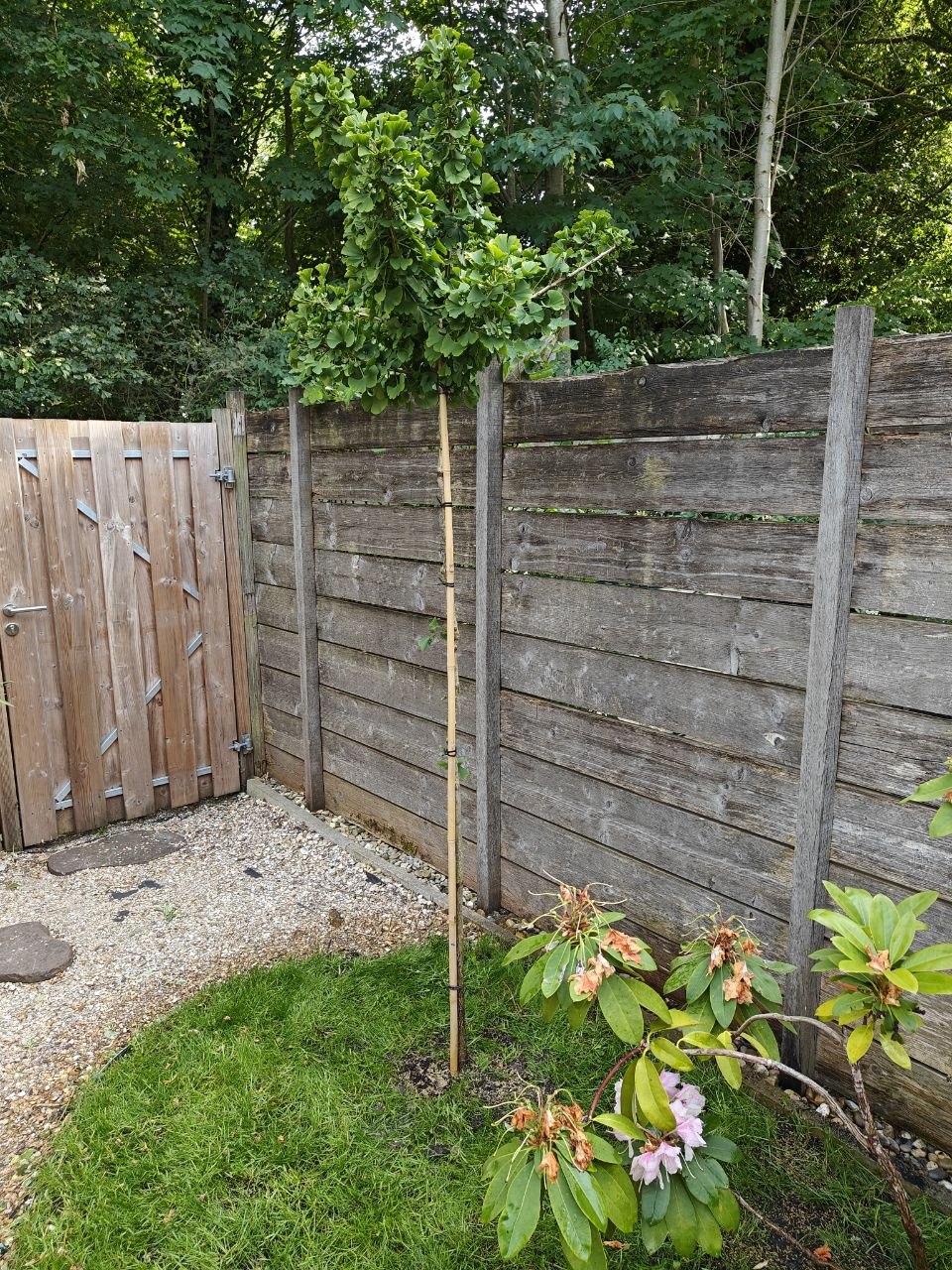
I also adopted this ginkgo tree. I had been fascinated by ginkgos ever since I learned they were evolutionary orphans. They are also very pretty in the fall. They are also one of the very few plant species whose sperm actively swims! I just hope this one will take root without too many issues.
❦❦❦
Another thing that happened in May is that I was sworn in to my city council, as a council member. This happened because a first member of my faction was promoted to representative and another dropped out, and I was next in line. I knew this could happen when I was elected to this position on that list back in March.
This is not a major change from my previous involvement in the faction’s meetings. I now also sit on the council meetings and I can vote on the decisions. The work is still rather limited. I read hundred pages long documents, review them, check that they are coherent and aligned with our strategy, and presented properly. I also get to ask clarifying questions to the people who write them. This is not very different from the type of review work I was doing in previous years; the main difference is that this only takes me two or three evenings per week as opposed to entire workdays (council member is not a full-time job). Maybe I will also get to propose new projects, but this is not on the agenda yet.
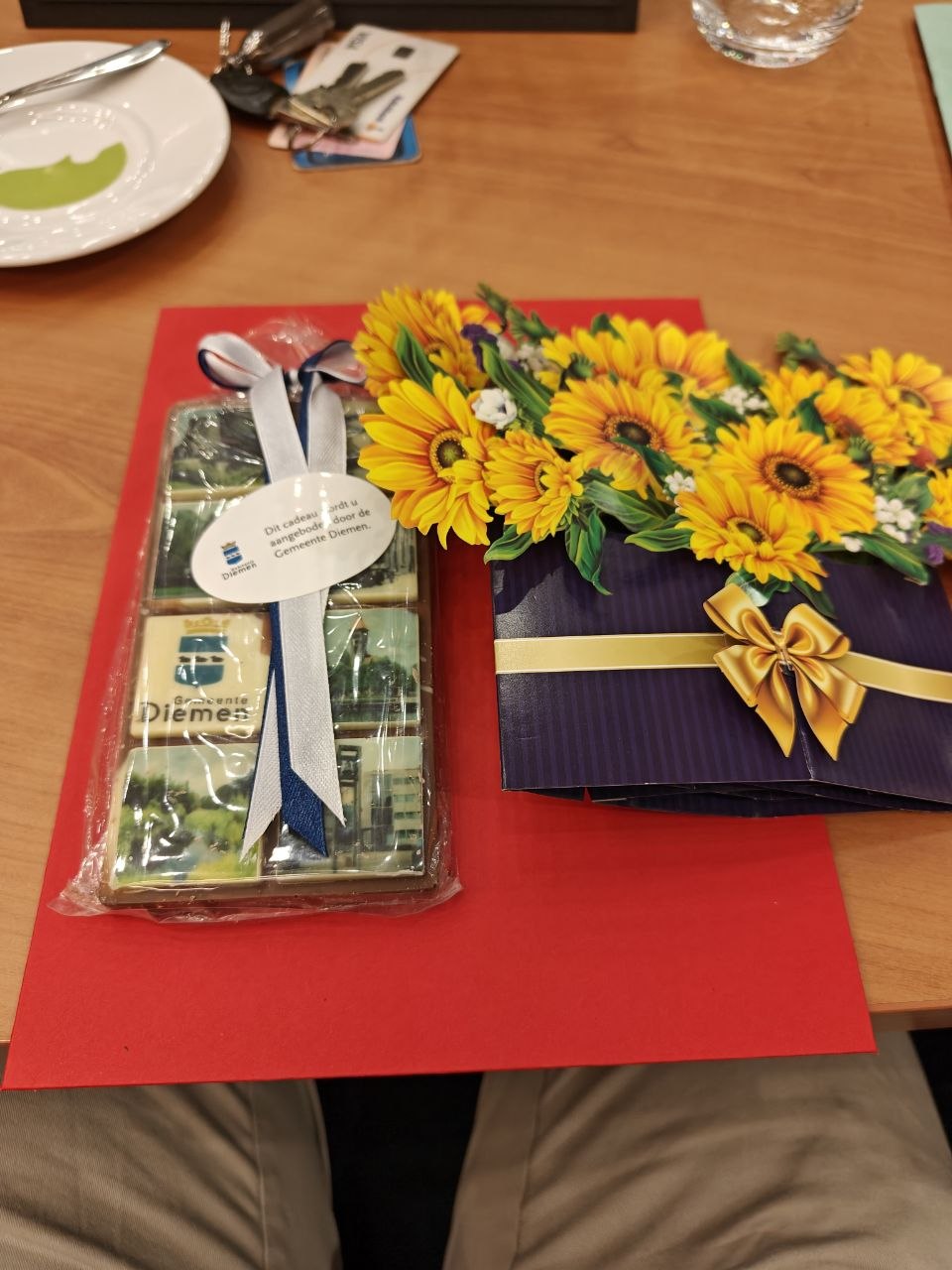
There were some decorated chocolates.
What surprised me is that there was a small ceremony. I had shown up just expecting some documents to sign in an office. Instead, there was a large room, many attendees from the public, and the other people who were also sworn in had invited their friends and family. Thankfully my shirt was ironed that day.
❦❦❦
This is as good a moment as any to share a brief word about how power is being organized in this country. In a nutshell, three principles are applied simultaneously.
One is the principle of locality: resources are funded and managed by the smallest scope that encompasses where they are shared. For example, the army is shared by the entire country so is managed centrally, highways are managed by provinces, and parks are managed by cities. Some resources are shared by multiple towns, e.g. fire brigades, and for these there are “associations” of cities to manage them (and fund them) together.
The second principle is delegation: certain services need to be provided equally to all citizens in an area and are thus funded centrally by the entity encompassing that area, but must be delivered by local communities. For example, public primary schools are funded by the state but built and run by cities. High schools are also funded by the state but run by groups of cities together.
The last principle is that ultimate responsibility is carried by elected bodies. For locally funded initiatives, executive power and accountability lies with the locally elected body. Civil servants report to the representatives who report to the council. Failure for a council to “perform” can only result in replacement during elections. For delegated initiatives, the local body reports on budget and outcomes: there cannot be any feedback or interference from the funding source if the budget closes without losses and outcomes match expectations set beforehand.
The areas fully under responsibility of a city council include (but are not limited to) education, spatial planning and housing, cultural development, transportation, social security, event facilitation, as well as local safety and crisis management.
❦❦❦
Last month, unusually, there was very little time left for reading between running my household, taking care of my health and making progress on my work project. I only picked up just a few noteworthy pieces.
Refreshingly, a non-LLM-related piece of sound engineering wisdom: The third hard problem by Roman Kashitsyn. Besides the two classic “hard problems of computer science”, namely cache invalidation and naming, Roman identifies tree mapping as another general area where practitioners often stumble into pitfalls. Tree mapping is the problem of taking a graph and structuring tree views of it for algorithms that prefer to work on trees. An example is the choice of whether to structure data in a row-major or column-major representation in a database schema. Another example is the choice to write a documentation guide with one chapter per theme, versus one chapter per educational level. Tree mapping problems do not have generally optimal solutions and good enough approaches are often contextual and a matter of experiential instinct.
❦❦❦
In You Need AI That Reduces Maintenance Costs, James Shore explains that LLM-assisted engineering does not reduce the overall volume of followup/maintenance work. Given that velocity is not infinite (even with evermore powerful/efficient inference, there’s always some ceiling on token throughput), mathematically we must always account for the overheads of taking care of maintenance, in the future, for work that’s being done today. The more work we do today, the more overhead we have in the future. It is possible to increase the velocity “today” so much that the maintenance overhead “tomorrow” becomes unsustainable. Unless we evolve our preference to start favoring LLMs that are better at maintenance specifically.
❦❦❦
One piece that generated some heated discussion online was Cut off by Anton Leich. It is very US-centric and, in my opinion, too enthusiastic about current trends. It gave me pause, however, and I felt compelled to revisit its main arguments 1) from the perspective of EU policymakers (which is close to my role now) and 2) taking into account additional risks and opportunities that Anton Leich did not recognize. You can find my write-up here: AI/LLM Access Policy for the World Outside Washington.
One of the arguments that both Anton Leich and I agree on is that current geo-political trends would make each regional power want, strategically, to increase its own compute capability, i.e. build more data centers. This is, in my opinion, true even if we end up not increasing LLM usage over time (i.e. we will want geographically local data centers even beyond the current AI/LLM hype) because governments are increasingly interested in increasing their sovereignty over data storage and processing.
However, there is political work to do. Datacenter buildout competes for hard resources (space, energy supply) with other land uses. In the Netherlands, this discussion is ongoing. From another angle, the politics of the job market evolution caused by LLMs are not being handled particularly gracefully and we can already see signs of knee-jerk political blowback. This tension will probably become one of the key debates of this decade.
❦❦❦
The last topic I’d like to cover today is the topic of life games. My thoughts on this are not fully clear yet and so this is a preview of what I might write more about later.
The train of thought started when I surprised myself thinking about Nethack, completely unprompted, more specifically the conduct feature of the game. Nethack is a role-playing game where you drive your character through a quest. While you play, you may choose to abide by additional rules regarding your character’s conduct without being asked to do so by the game itself. For example, you can choose to have your character never kill a monster, i.e. play as a “pacifist”. Some conducts are recognized by the game code at the end of a gameplay (e.g. pacifist, atheist, illiterate); whereas some conducts are purely a player choice without in-game reward, for example being “survivor” (i.e. never being saved by an amulet).
Choosing a conduct in this game makes its playthrough genuinely more difficult. Given that most conducts are not particularly rewarded, one may wonder: why would a player even choose to follow a conduct?
On a tangentially related note, a year or two ago I had a conversation with a friend on the nature of competition, for example in sports. During that conversation, my friend was asking if I would ever be interested to practice as much as necessary that I could compete in a championship. I pointed out that I do not find it particularly pleasant or interesting to compete on any public activity with the aim to become “the best” in that competition (e.g. achieve the top 10% of outcomes); not because I lack a competitive instinct, but because I know that there are always people who are choosing to focus most of their life on becoming the best at that one thing, and I can never expect to reasonably compete with them because I am choosing to also prioritize other things in my life. Because, generally, I care about having more of my needs being met simultaneously.
Incidentally, this point is also made in the following interview, which I thought was enlightening. It’s relatively short and the point is well-made. I encourage you to give it ten minutes of your life.
I felt that Nethack conducts and life priorities relating to competition are connected somehow. This feeling was further strengthened by this lecture:
The main point here is that Minecraft is not a game, insofar a game can be characterized as a playground combined with:
- a set of rules.
- one or more paths to success defined in-game.
- in-game friction that defines a skill progression to achieve the game’s success criteria.
In the author’s words, you can recognize that something is a game if you can cheat in it: taking a shortcut to achieve the in-game success while bypassing either the rules or the skill progression. Within this definition, Minecraft is not really a game: using “creative mode” and mods to bypass the rules or remove the friction is a valid modality to interact with it - people don’t consider this cheating.
However, we can also choose to abide by arbitrary rules or progress friction within a Minecraft session. For example, we can choose to eschew creative mode and mods and race a Minecraft parkour map, aiming for personal skill development (better times against one’s own previous runs) or in a competition (against other players). Once that choice is made, it becomes possible to cheat, and we have created a game inside the Minecraft playground.
With this perspective, we can recognize that adopting a conduct inside Nethack (as explained above) is really choosing to “play another game inside the game.”
After watching this lecture, I was left wondering: to the extent that real life is a playground, what are the rules, success criteria and skill ladders we can choose personally, outside of social norms and expectations? What are some worthy “conducts” that result in a life that’s dignified, albeit perhaps not conventionally rewarded?
Conversely, within the games that society has us play, are there shortcuts one can take that are both ethical and legal? Can we effectively “cheat” society’s rules for the game of life?
❦❦❦
References:
- Wikipedia, Maastricht.
- Wikipedia, Ginkgo biloba.
- Ginkgo biloba sperm cells swimming, YouTube.
- Roman Kashitsyn, The third hard problem, mmapped.blog.
- James Shore, You Need AI That Reduces Maintenance Costs, 2026.
- Anton Leicht, Cut off.
- Raphael Poss, AI/LLM Access Policy for the World Outside Washington, 2026.
- NL Times, Permitted large data centers in Amsterdam, Lelystad move ahead despite opposition, March 2026.
- Vox, Data center moratoria and the AI backlash.
- Wikipedia, NetHack.
- NetHackWiki, Conduct.
- Wikipedia, Minecraft.
- Angelo Somers, Psychotic Ambition Is A Mental Illness We Applaud, YouTube.
- Fractal Philosophy, Minecraft Is Not A Game, YouTube.