April Update
For this month’s newsletter, I’m going to try something slightly different. I am still not planning to use LLM assistance to author anything, but this time I am trying dictation and am using a LM (not large) to transcribe my voice. This means that my style is going to be different because it is reflecting my spoken dialect instead of my usual written language.
Incidentally, this was the first time I found a language model that does voice approximately properly, with auto inference for punctuation. For reference, the model is Whisper and the harness for it is Voxtype and I’m using it with eager mode to reduce transcription latency.
❦❦❦
I recently reflected on the topic of writing as a mechanism to transform and settle emotions. For context, I strongly believe in the power of journaling, and I regularly recommended it to the people I mentor. Ironically, my own journaling practice is somewhat spotty. Most of my long-form writing has taken place in this newsletter. Yet I am making an editorial choice to restrict the topics I cover.
For example, I don’t cover the identities of the people I spent time with. I don’t cover the nature and texture of our relationships, conversations and most of our shared activities. I don’t usually cover the ambitions or hopes that I nurture from week to week, or month to month: I usually only focus on the outcomes after they have been reached already. I rarely cover the food I eat or most places I visit through a week. I only write about few of the experiments I make and a little of the stuff I study. I also do not comment on projects to travel or to meet people before they happen. I do not write about the music I listen to, most of the games I play, the movies I watch, and all the thoughts and feelings I experience in connection to the people I have seen recently or want to see again soon.
Meanwhile, another part of the truth is that all these topics actually do occupy 80% or more of my time, my thoughts, my emotional life, and my priorities.
I chose to transcribe the remaining 20% of crusty and intellectual topics of my life into a newsletter partly because I thought that they might be of interest to you and partly (a bigger part) as a way to limit their hold on my consciousness. By writing those things down, they “exit my system” and I do not feel compelled to think about them any more. This frees up time and availability for the other topics listed above.
Conversely, if I did not write, or rather, when I’m thinking about my life before I started writing, these crusty topics would invade my mind and I would feel much less available to experience a balanced and dignified life.
But then the question arises of whether I could (should?) additionally be writing about the other topics that actually take most of time and my energy. Would it enrich and/or transform my emotional experience of them?
I think about this a lot. There are some people privacy issues that I could want/need to deal with if I wrote more, but I consider that a detail. Instead, I fear that if I were to write about these things, then they would also “exit my system” and become less important. And I don’t want that.
Of course, I’m not entirely sure that it would work like that; maybe more comprehensive journaling could help in ways I don’t understand yet. But I still find the risk too costly.
Meanwhile, thinking about this also made me think reflexively on how I read stories by other authors. I love reading stories, but now I also like to think about all the parts of an author’s life that we do not see through what they write.
❦❦❦
The remarks above notwithstanding… There is still space in this newsletter to share some of what happened this month.
At the very beginning of April I went to visit my mom. I’m realizing I did not write much about this recently. There were a couple of transitions in her situation through this first half of the year that were very difficult for her, and for me to write about. And the last one that motivated my travel at the start of April was one that was particularly difficult. I gained some additional experience with panic attacks.
Thankfully, the place that is now handling her is doing a slightly better job and, if I’m to believe the pictures that I received after my visit, she seems to be doing gradually better—at least regarding her physiology. Obviously, with limited blood circulation in her brain, certain things are never going to become better. But that is something I had accepted already last year.
❦❦❦
I came back home when everything started blooming. In particular, I was very happy to see that the tulips that the previous owner of my house had planted on the front porch finally opened.
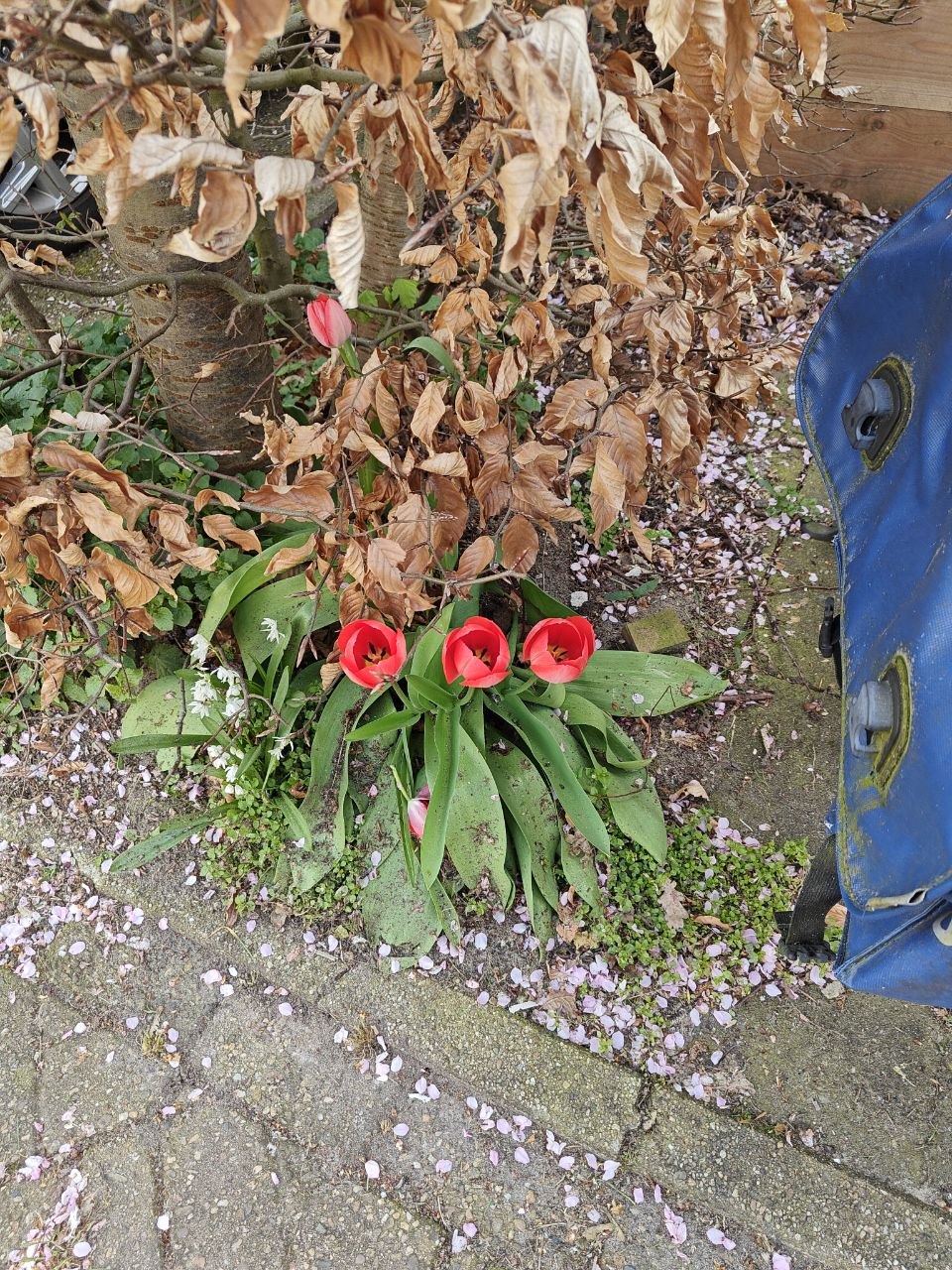
They are a bit hidden underneath the hedge.
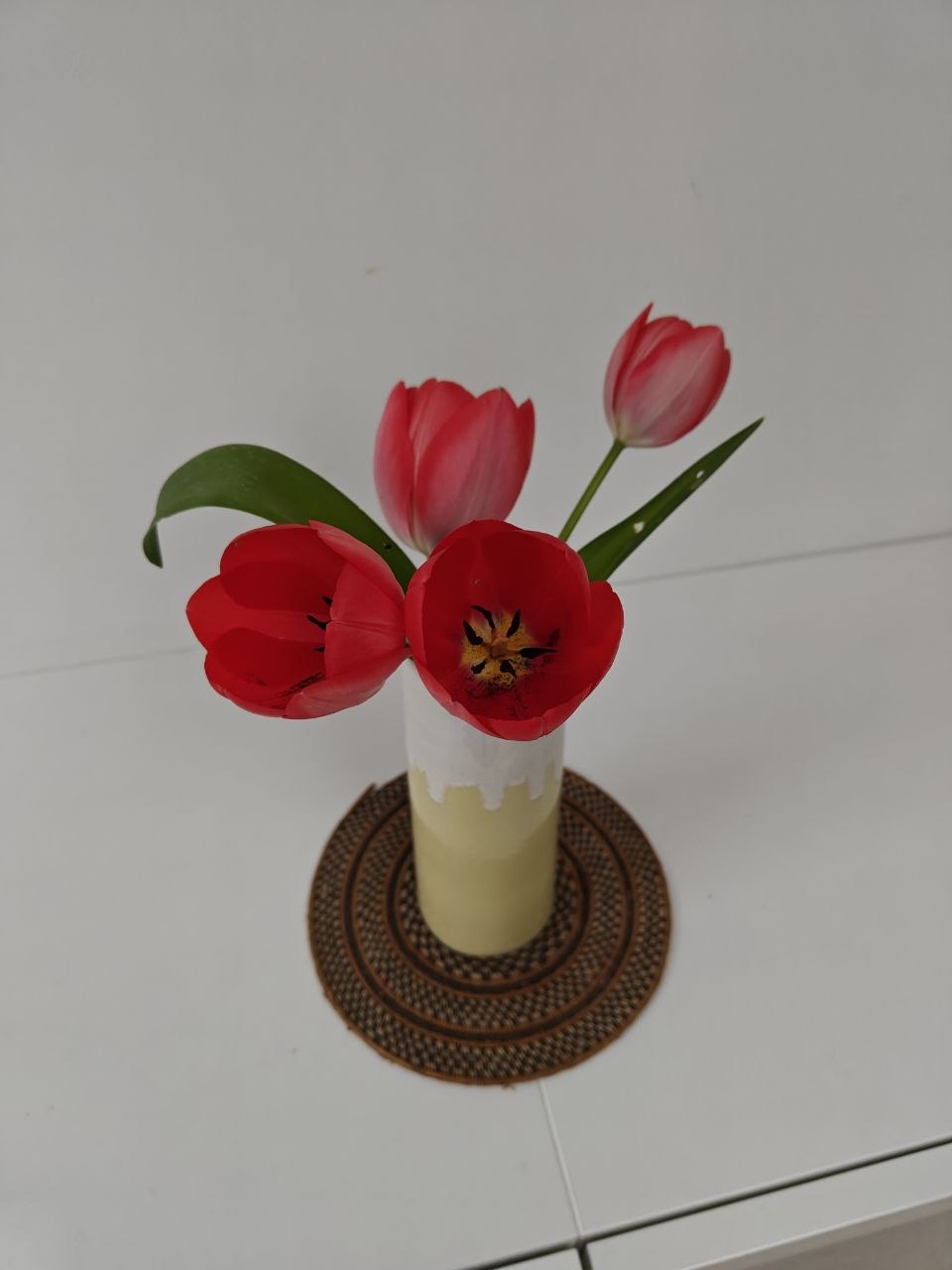
My first time putting them in a vase!
❦❦❦
I was also invited to an introduction day organized by the government of my province. The purpose was to help people who are part of city councils, or attached to city councils, network with each other and learn more about the functioning of this provincial government. I did learn a few things and that might actually come handy later.
Additionally, the provincial government gathers weekly in a meeting room in a palace. The palace was originally built for the government’s business, then turned into a museum, but the government can still use it for business outside of museum hours. This is a weird arrangement that emerged when the power of provinces devolved to the central government in The Hague and there was less government money locally to maintain a palace. The palace still looks fantastic though.

The furniture available to guests is actually 100-150 years old. There are guards who check that the visitors sitting on these chairs do not damage the chairs.
❦❦❦
Another thing I did was to go on a forest hike in the neighboring province. It was a strange experience. I’ve never been walking so much in the forest in the Netherlands before. I didn’t have the right shoes, it burned a little bit, but the nature was very beautiful.
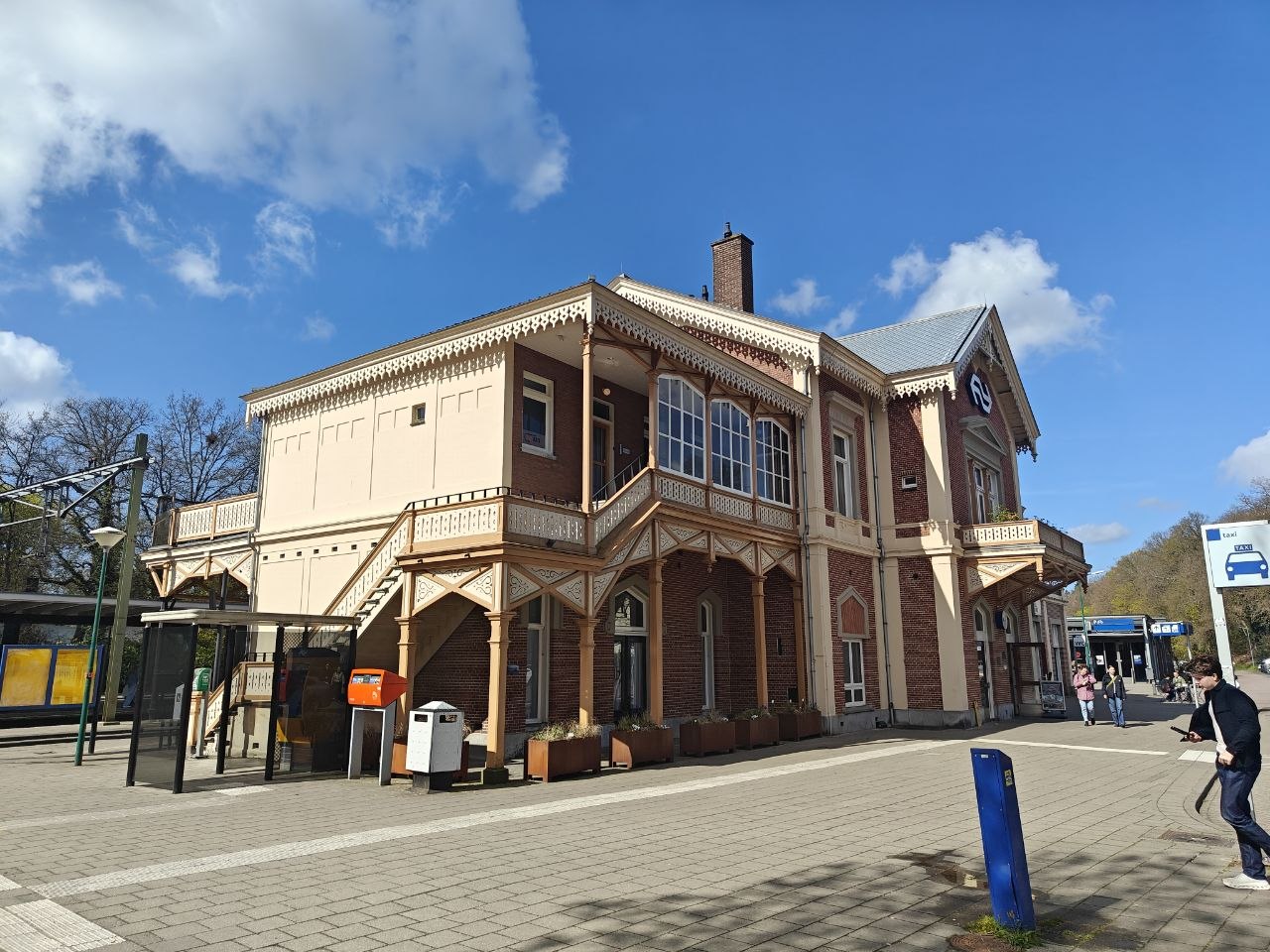
The train station in the town of Baarn where the hike started. It uses a unusual architecture. I’m not exactly sure what this is, it reminds me of the colonial style used in Louisiana and other places in North America. Seeing this inside the Netherlands really surprises me.
❦❦❦
I also took a minute to reflect on the fact that April is really the month when I take a lot of pictures of flowers. I think I just like thinking about flowers and taking pictures of them. There were a lot of pictures taken this month.

I really like magnolia trees and magnolia flowers. I also learned this month that you can eat them. I haven’t tried yet. Allegedly they should taste like ginger.
❦❦❦
Separately, I also traveled to New York City in April. The main purpose of my travel was to gather inputs from folk I know regarding my project. I will explain this a bit more below, but we also took time to visit the Brooklyn Botanic Garden which at this time was absolutely amazing.
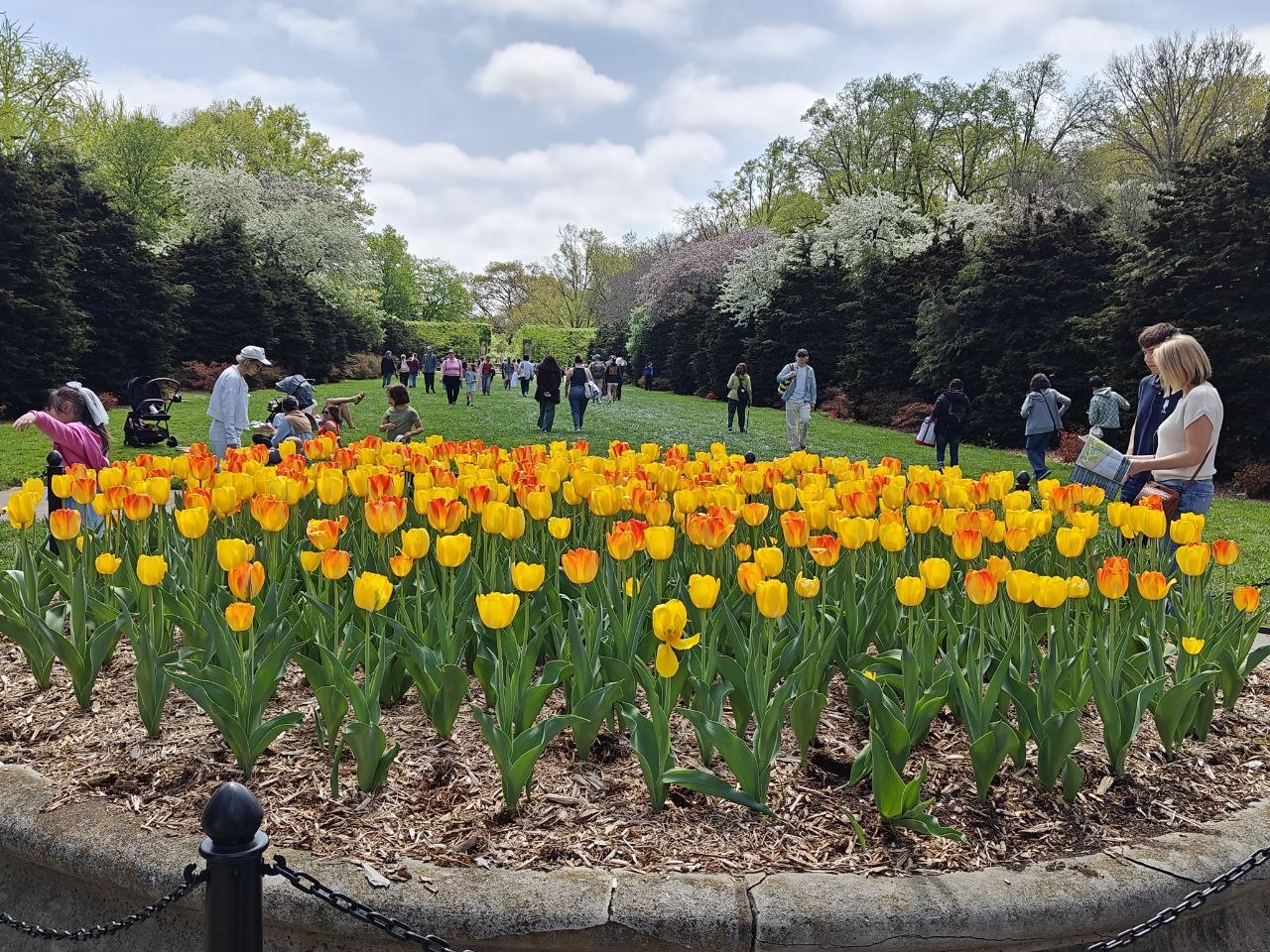
Brooklyn Tulips.

Brooklyn Maple Tree.
❦❦❦
Again, I enjoyed visiting my friends in Saugerties in the north of New York City. They live in the countryside and I welcomed the break from the buzzing city. One thing that happened there, that I still think about to this day, is what I was given when I ordered “a side of pickle” with my sandwich.
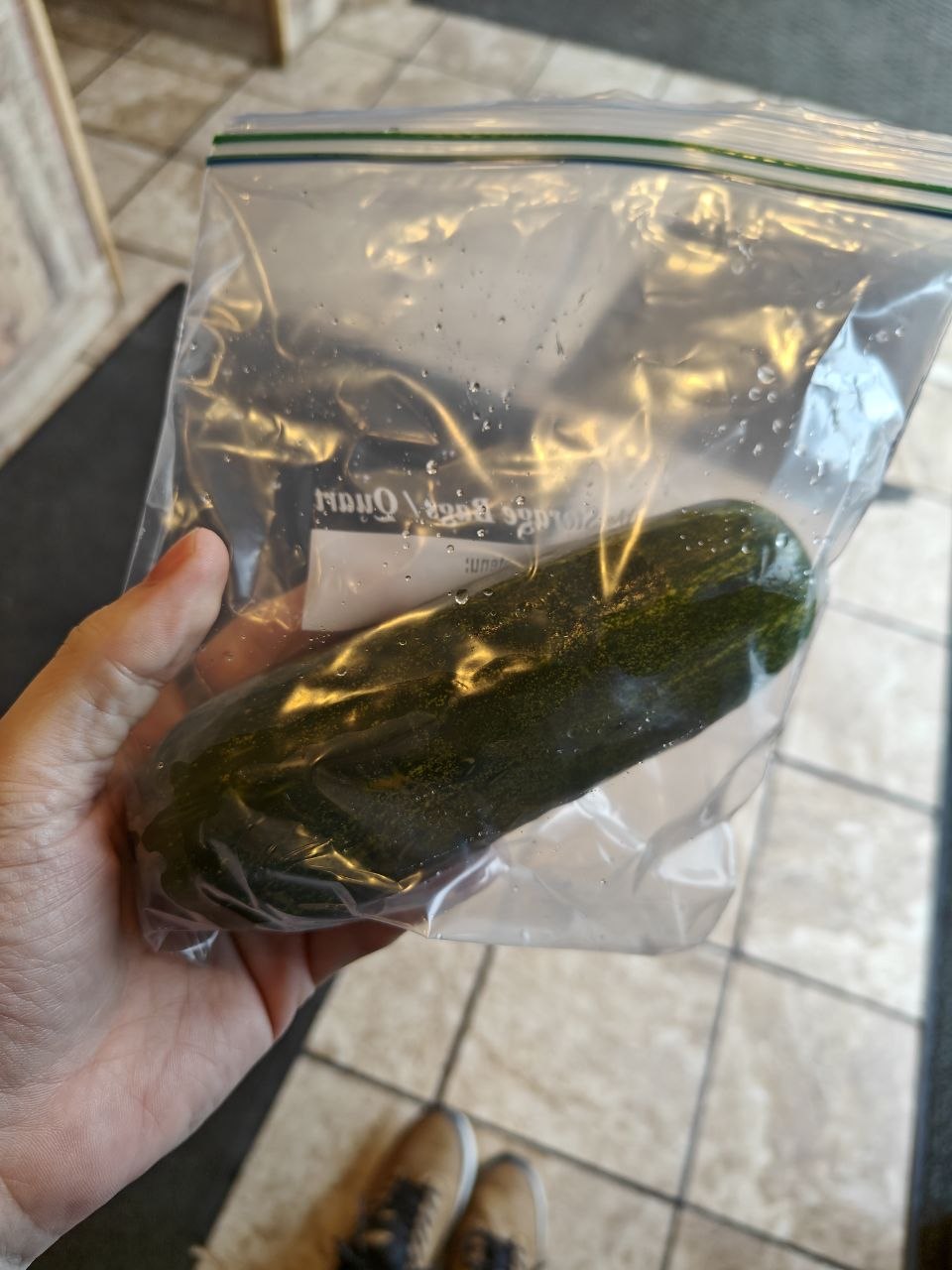
This pickle was as large as an eggplant. I had to spread it across three meals to finish it.
❦❦❦
Another fun thing that happened with my NYC friends was our organizing of a cheesecake contest of sorts. For context, two months ago, our group was arguing about which kind of cheese should be best used in a cheesecake, and so we put this to the test through a bake-off.
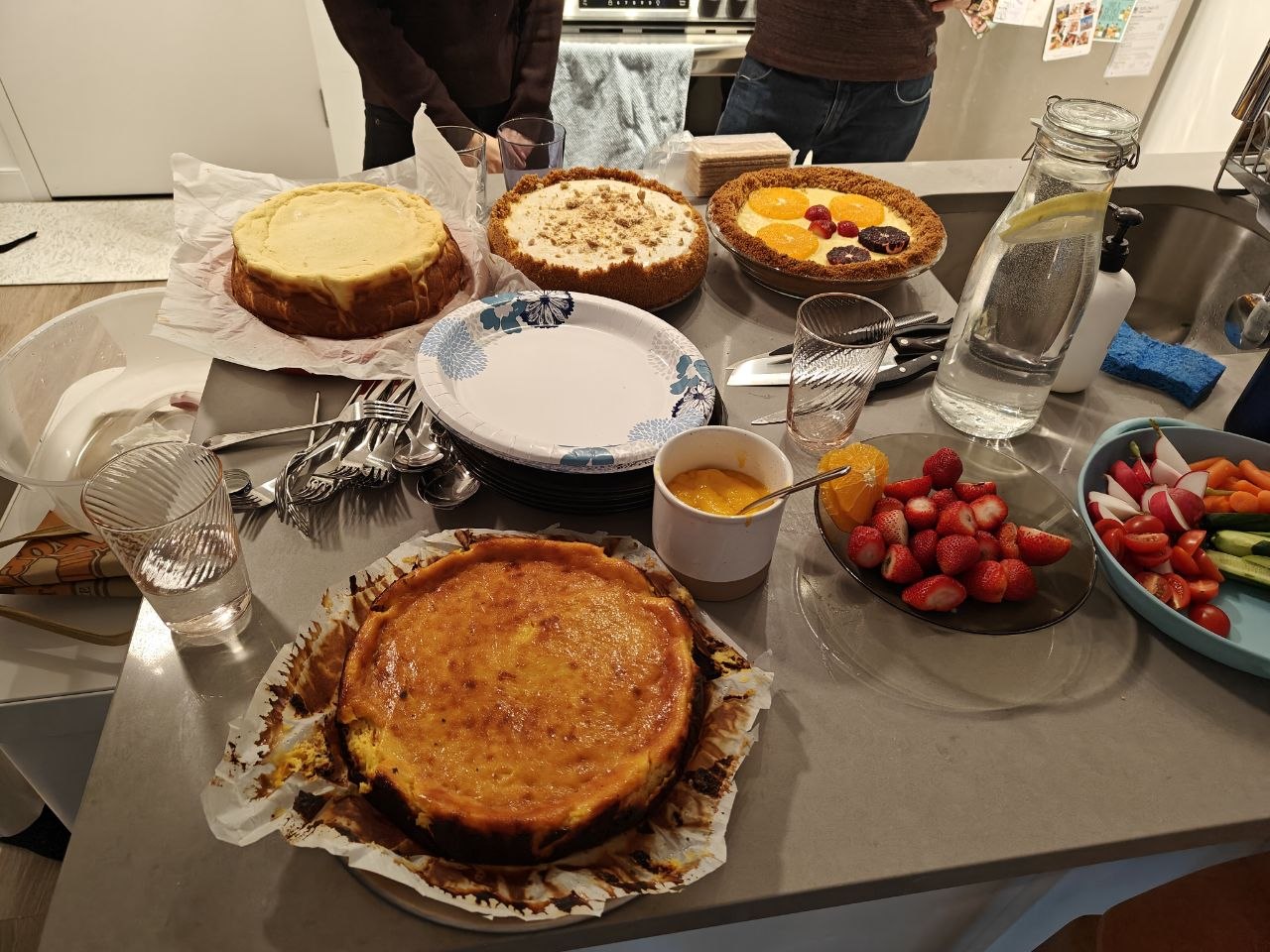
We originally had five contestants. Sadly, one of them dropped out at the last minute. Nevertheless, the four cakes were delicious. Very different tastes, very different consistencies and very different experiences. I enjoyed them all. We are likely to do this again.
❦❦❦
Coming back home from New York City was a little bit of a bittersweet experience. Once again, through this travel I had a very happy time with my friends. I have missed them very dearly on my journey home and then spent again a significant number of hours reflecting on the difficulties that come from living far from friends and family.
As I landed back home, however, spring was still happening.

More flowers from my yard.
I also experienced spring cleaning energy. I allocated it to errands that had been postponed previously, but also to think a little bit more about decorating my home further this year. The first action that I took was to frame a gorgeous pixel art image that I found last month.
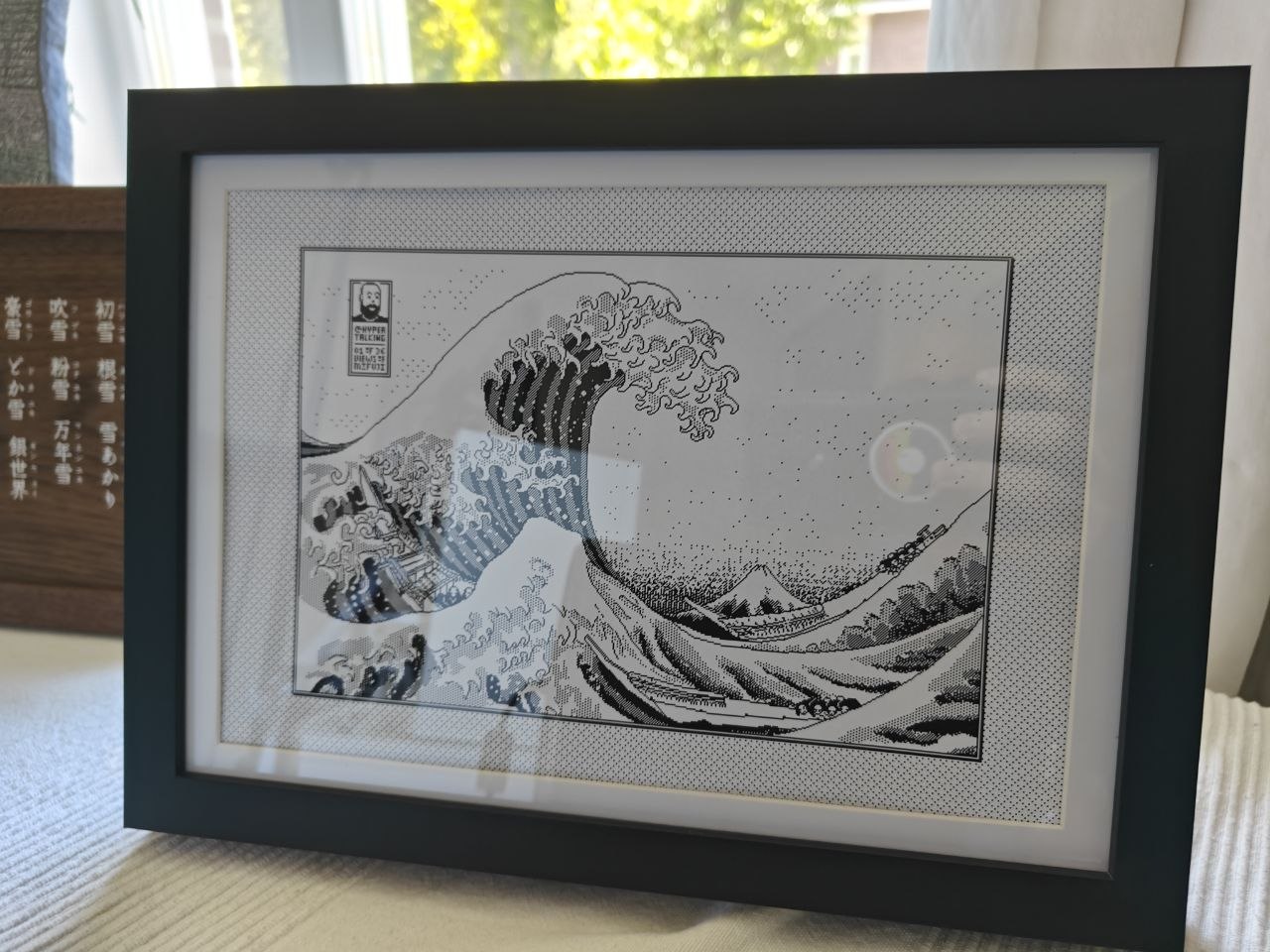
I chose the style of the rendering for the nostalgia, but the subject of the art is just as magnificent as the original. I feel great every time I look at it.
❦❦❦
The last thing that happened before I started writing the newsletter happened actually after I opened the file in my text editor: on Monday, we celebrated remembrance of the people lost to World War II. The ceremony was organized by my city hall. It was beautiful & very well organized. We had children from local schools reciting poems and a local orchestra performing parade music. The flowers were amazing, and, for the very first time, I heard the city bell! An actual, huge non-church bell. It was hanging there and I had never noticed it before.
I felt it was important to me to witness an example of a non-religious yet symbolically laden ritual, as this happens to be relevant to my other work. It was also heartwarming to see it shared by a very diverse set of people across all classes of society.
❦❦❦
One of the two nerdy topics I want to share today is that I have started playing Beat Saber, as way to enhance my upper body fitness.
In case you’re not familiar, Beat Saber is a movement game that you play with a virtual reality headset. You are presented with blocks that come at you in rhythm with some music tunes and you have to cut through the blocks with two sabers that you manipulate through your hands.
I already had good prior experience with rhythm games, thanks to my expertise with Dance Dance Revolution. However, I had underestimated how much more complex the movements we can make through our hands are, and the game takes full advantage of that. Needless say, I am making very slow progress. And my shoulders are really taking a beating. Which I need to be very careful about, given that I’m still not fully recovered from my frozen shoulder situation from last year.
The part about playing the game is the fun part of this story. The less fun part is my profound disappointment at the state of technology around VR headsets and the integration with video game technology stacks. For example, what is considered to be state of the art is using some device from the Facebook company that makes it mandatory to report to Facebook all the things you do inside your VR headset. I find this completely unacceptable.
The device I chose does not mandate you report to their company; however, it is a system that is derived from Android and the state of software for the Android platform is also kind of disappointing. For example, the game streaming software that I needed to use to run games from my desktop computer does not really work over a USB cable, and the Wifi mode was jittery. Just disappointing in so many ways.
❦❦❦
The frustration I experienced above made me reconsider my gaming technology.
For context, I use a desktop computer for gaming that is situated in my living room. This is a gaming computer I bought secondhand, something like 12 or 13 years ago. Back then, it was not even new: the components are from 2011. That said, this gaming computer has helped me throughout the years, has been a great experience, and I’m still able to run quite a few recent games from the last couple of years (thanks to a GPU upgrade 6 years ago). So, by the standards of my own use of video games, it was very much sufficient.
Until the VR story started, of course. Driving two small screens each at 4k pixels is quite an endeavor for a 15 years old computer. Even though I feel comfortable with big pixels and slow frame rates, I do have to admit that making progress in a rhythm game with fast music does actually benefit from a higher frame rate and a higher resolution.
So the next chapter in this nerdy story was to decide what to do if I wanted to upgrade the hardware. In particular, I was not keen to create space in my home for an upgrade to Windows 11. Throughout the last two years, I have been horrified by all the misery that Windows 11 users go through every day; I was already convinced many times over that that software would never pass the threshold to my home.
The tension that come from that decision pertains to its consequences with regards to compatibility with the VR headset that I just recently acquired. What were my alternatives and how good were they?
This is where the story gets a happy ending. Together with a friend, we ran an experiment with something called PikaOS which apparently has been well optimized for gaming computers. We were very surprised that it took us less than an hour to set it up, and that most of our game library could work on it straight away. I cobbled up a new computer from pieces I had laying around, then with PikaOS, WiVRN and WayVR, I am now fully set up with capabilities that far exceed what the paid software that I was using previously could provide.
❦❦❦
The other nerdy story that I would like to share is actually a personal milestone.
For context, I like to use sound notifications to signal various steps in long automated tasks in my work so that I can focus on something else and use the auditory notification to pull my attention back only when needed, e.g. when an error happens or a program needs more input from me. This way, I don’t need to switch back and forth all the time. Given that most of my development is happening on FreeBSD, for many years—probably 10 by now—I have been using the speaker(4) driver as a mechanism to generate small chirping noises through the integrated speaker inside the development computer.
Sadly, in the last two versions of FreeBSD, that driver was slated for removal because it was using deprecated APIs and nobody had stepped up to fix it. So last December I prepared a patch to upgrade that driver to the modern interfaces and I also submitted it to the FreeBSD team. Initially, in January and February I became somewhat disenchanted because I was not able to receive good reviews and there seemed to be no interest to adopt my patch, but then I met someone in New York City who was able to help. It went in!
So even though I did this merely to safeguard my chirping noises, as of two weeks ago, I have become officially a FreeBSD contributor. This is something I had dreamed of ever since I started using FreeBSD, back when I was 21.
❦❦❦
Another life-important thing that happened in April is that I started attending so-called “men’s circles.”
For context, I had known for a couple of years now that this is something that I felt drawn to. But there had been little motive and opportunity to attend one. (A “men’s circle” is a discussion/support group for men that is organized to be both emotionally safe and confidential.)
I chose to make the step and join the first one the week before I traveled to visit my mom because I perceived, accurately in hindsight, that I would need help from other people to deal with this. The experience was very good. So I chose to continue to explore this area of my social life and I went to multiple similar events throughout the month.
With the experience of several meetups, three points stick out so far.
The first one is that it works—it’s not just hippie fluff, as I might have believed several years ago—and induces a good dose of purpose for all participants.
The second point is that I saw something tragic. I met people, not just men, who attend these type of events because they feel isolated, because they need help with emotional regulation, or because they need to be surrounded by people when making hard decisions or dealing with difficult situations. There are so few events available for this! And some of them even cost money to attend: I see people attending the paid events and relying on those events while having to pay to attend. This is what makes me feel sad: seeing people having to pay for social connection. I find it scandalous; an abdication of what a society should really be.
The last point is that I don’t know yet how long I want to participate in these events as a mere attendee. The events I have attended so far are not nearby. I’m thinking that organizing my own recurring event might help me and folk in my local community better. Without charging for it, of course.
I’ll be attending a few more events while I noodle on this topic further. Stay tuned.
❦❦❦
Work-wise:
- Last quarter I completed a first version of the back-end of my app, and so I started to work on middleware to orchestrate data storage and synchronization across devices and users. It turns out that the combination of specific user outcomes I am targeting (local-first storage, end-to-end encryption, multi-user collaboration and option to self-host to increase user trust) have not yet been explored together before, and so I cannot use off-the-shelf solutions. This is also why I wanted input from the folk I know in NYC. This phase will likely keep me busy for a month or two more. So much for not wanting to build a business centered around technology!
- At the start of the year I became interested in authoring a guide to help younger people / less experienced people navigate the appearance of LLMs in the tech industry, with regards to their career development. I ran interviews to gather input from people in my network throughout two month, and just published the resulting report: LLMs in Software Engineering What Experienced Practitioners Actually See.
- I made an executive decision to boycott anything produced by OpenAI, due to value incompatibilities with that business’ owners. There is a non-negligible chance this will also happen with Anthropic. Meanwhile, we are now entering an era where there is more competition so I do not feel impaired with my choices.
- That said, I am continuing to shave off “long tail” projects from my never-ending list thanks to LLM agents I can prod while doing something else. The major quality-of-life improvement that LLMs helped me with recently was to capture my Home Assistant configuration into a source code repository, so I can more easily restore it if the HA controller ever fails.
❦❦❦
April was also the month where I transitioned back from reading fiction to a bit more non-fiction.
- Somewhere Beyond The Sea - TJ Klune
- This is the sequel to The House in the Cerulean Sea I read last month. It’s not quite as good but I still enjoyed it. I was also happy to read there may be an animated series coming.
- Only You Can Save Mankind, Johnny and the Dead, Johnny and the Bomb - Terry Pratchett
- These three short novel for young adults feel like a side project in T.P.’s bibliography. They were an OK read, but I had a distinct feeling T.P. was merely adapting themes and ideas from other well-known works from the same era.
- Strata - Terry Pratchett
- This one, on the other hand, was surprisingly fun to read. It is one of his earlier works, and does not use the humoristic style he was known for in his latter years. T.P. is not an experienced science-fiction writer, and you can see this through his uses of borderline fantastical technological non-sequuntur and an annoying resort to Deus ex Machina right when the story was getting interesting. The characters were surprisingly well written though.
- King, Warrior, Magician, Lover - Robert L. Moore & Douglas Gillette
- I read this upon the recommendation of one of the people I’ve met through a men’s circle. It is an interpretation of the model proposed by Carl Jung at the beginning of the 20th century, that our personalities are composed of various archetypes in combination with their shadows. The authors of this book go a couple steps further and simplify Carl Jung’s ideas to a model with eight archetypes, with two shadows each, just for men. I personally think the views professed in this book are too simplistic and do not account for the diversity of people I’ve met in the last couple of years. I was also wondering why some people in these circles like the book so much. So I went further and investigated other things written around the same period. I learned that there was a fad at the end of the 20th century to create myths that explain who we are through the lens of psychology. That fad coincides with the mass secularization of Western society around the same period. There were also other books trying to do similar things for female audiences. I think my main takeaway is that people really would like to have myths to explain their lives and they will take those myths from pretty much anywhere.
❦❦❦
The following three pieces are really about upcoming large shifts in the invisible power dynamics underlying the fabric of western society.
In Why the Most Valuable Things You Know Are Things You Cannot Say, an anonymous author reminds us that humans learn to do complex stuff in ways that they cannot explain with language afterwards. “The inability to articulate the model is not evidence of a crude model. It is evidence of a model too sophisticated for the transmission channel.” This, in turn, creates a tragedy of governance: “Institutions that allocate authority based on legible credentials systematically promote book-smart people over street-smart people, which works in knowledge domains and fails catastrophically in judgment domains.” The author then points out that many organizations do not deal with expertise properly, by overly trying to codify “level-four”, intuitive knowledge into processes and frameworks that become brittle and vulnerable to changes in circumstances. The main takeaway is a warning:
The most valuable forms of human expertise are precisely the forms that resist formalisation. They are learnable but not teachable, acquirable but not transmissible, demonstrable but not articulable. Every attempt to compress them into a transmissible format destroys the information that makes them valuable. The only reliable method of developing them, which is prolonged calibration through direct experience, is the one method that cannot be scaled, standardised, or accelerated beyond a modest degree.
In What’s Missing in the ‘Agentic’ Story, Mark Nottingham reminds us that most artifacts that connect us through the internet are really intermediates that act on our behalf to do things with/for other people. We learned to trust them historically because for the longest time, the layers of technology were arranged in such a way that the interests of their producers and users are aligned. This is changing in recent years, with more and more parties abusing this trust.
Within this context, the author points out that standardized, uniform “user agent” programs, like web browsers, act as a sort of protective shield for the interest of end-users. It has everything to do with bargaining power: forced to negotiate features/prices/information site-by-site, individuals would lose—we would give up out of exhaustion. A standardized user agent—like a web browser—forces the sites to comply to the agent’s expectations, lest they would lose the multitude of its users as an audience.
Within this additional context, the author points out that LLMs today lack a well-defined “user agent” role. We see too many one-off projects and custom interfaces developed using LLMs, such that each individual user gets a wholly different experience of connected internet services. Organizing our interactions in this fully customized way fails to shield us from nefarious actors through collective bargaining and we have not yet fully understood the consequences of this choice.
The author proposes:
Creating an agent role for AI – with all of the benefits to the user and market that brings – will require constraining the tools that it can call in a fashion that becomes ‘normal’, so that people can depend on how it behaves. That might involve standard tool APIs with appropriate constraints, permission models, sandboxing (TEE or otherwise), and much more.
All of these issues are currently swept up under the carpet of ‘security’ in many AI discussions. We need to start talking about them with more nuance. Security is a defensive posture; agency is a collective bargain.
In How Silicon Valley Is Turning Scientists Into Exploited Gig Workers, Hirsh Chitkara writing for The Nation points out that private equity is currently plundering the scientific arm of the US American government (both by assassinating the reputation of academic institutions and manipulating the government to de-fund them, both in the interest of capturing all its scientific researchers), sacrificing the collective and long-term opportunities of public science on the altar of short-term gains for venture capital. Or, as the author puts it:
“The new bargain struck by Silicon Valley conflates wealth generation with progress. It is akin to deciding that a tree’s roots no longer need to be watered because the fruit comes only from its branches.”
The question, for me, will be whether/how we can restore this balance after the current hype wave dies down.
❦❦❦
I was also happy to learn:
- De machinerie van de volkshuisvesting by Carlijn Kingma (Follow The Money). How government and private interests orchestrate housing in the Netherlands, what broke in the last twenty years and what we could do to fix it.
- If America’s So Rich, How’d It Get So Sad? by Derek Thompson. The most intriguing finding is that happiness has generally decreased in English-speaking cultures and increased in non-English-speaking cultures, but the author points out the latter also suffered less inflation, so it’s not all about language. The proposed explaining theory is that since 2020 we had to weather more crises than usual, we are more exposed to them through online news, and we have less ability to weather them through social connection (too much individualism + poisoned social media) and leisure activities (too much inflation).
- Why Swedish Schools Are Bringing Back Books by Joshua Cohen. This is a bit of good news, masquerading as a scientific finding: kids do better in school without devices and with books.
❦❦❦
A bit more on the exploratory side, “ideas to make you think”:
The Bonkers Theory That Ancient Civilizations Weren’t Conscious - in a nutshell, consciousness emerged as the interconnection between the two hemispheres of the brain. Before that, people did not realize when one side of their brain was doing something that the other side did not fully understand, and misinterpreted this duality as gods and spirits speaking to them.
Humans Are Still Evolving and In Some Really Bizarre Ways by Anton Petrov (this guys is underrated). A few of the examples are specific to cultures bound to geographical regions, but one made me raise my eyebrows: that modern society is slowly turning us into ant colonies, where individuals have no hope to survive without the collective and we’re OK with it.
❦❦❦
References:
- Voxtype.
- Wikipedia, Whisper (speech recognition system).
- Province of North Holland, Paviljoen Welgelegen.
- Hypertalking, 1-Bit Pixel Art of Hokusai’s “The Great Wave Off Kanagawa”, May 2023.
- Wikipedia, The Great Wave off Kanagawa.
- Beat Saber.
- Wikipedia, Dance Dance Revolution.
- PikaOS.
- WiVRn.
- WayVR.
- FreeBSD, speaker(4) — device driver for the speaker.
- LLMs in Software Engineering: What Experienced Practitioners Actually See. April 2026.
- T.J. Klune, Somewhere Beyond The Sea. 2024.
- T.J. Klune, The House in the Cerulean Sea. 2020.
- TheWrap, ‘The House in the Cerulean Sea’ Animated Series.
- Terry Pratchett, Only You Can Save Mankind. 1992.
- Terry Pratchett, Johnny and the Dead. 1993.
- Terry Pratchett, Johnny and the Bomb. 1996.
- Terry Pratchett, Strata. 1981.
- Robert L. Moore & Douglas Gillette, King, Warrior, Magician, Lover. 1990.
- Wikipedia, Carl Jung.
- Wikipedia, Jungian archetypes.
- anonymous, Why the Most Valuable Things You Know Are Things You Cannot Say, Dead Neurons.
- Mark Nottingham, What’s Missing in the ‘Agentic’ Story. 2026.
- Hirsh Chitkara, How Silicon Valley Is Turning Scientists Into Exploited Gig Workers, The Nation.
- Carlijn Kingma, De machinerie van de volkshuisvesting, Follow The Money.
- Derek Thompson, If America’s So Rich, How’d It Get So Sad?. 2026.
- Joshua Cohen, Why Swedish Schools Are Bringing Back Books, Undark, April 2026.
- The Bonkers Theory That Ancient Civilizations Weren’t Conscious, YouTube.
- Anton Petrov, Humans Are Still Evolving and In Some Really Bizarre Ways, YouTube.