March Update
Happy April 1st. No joke from me here; spring has started at last.

As of April 1st, my tulips are about to bloom.

Our cherry blossom comes in two variants: pink and white. White is my favorite.
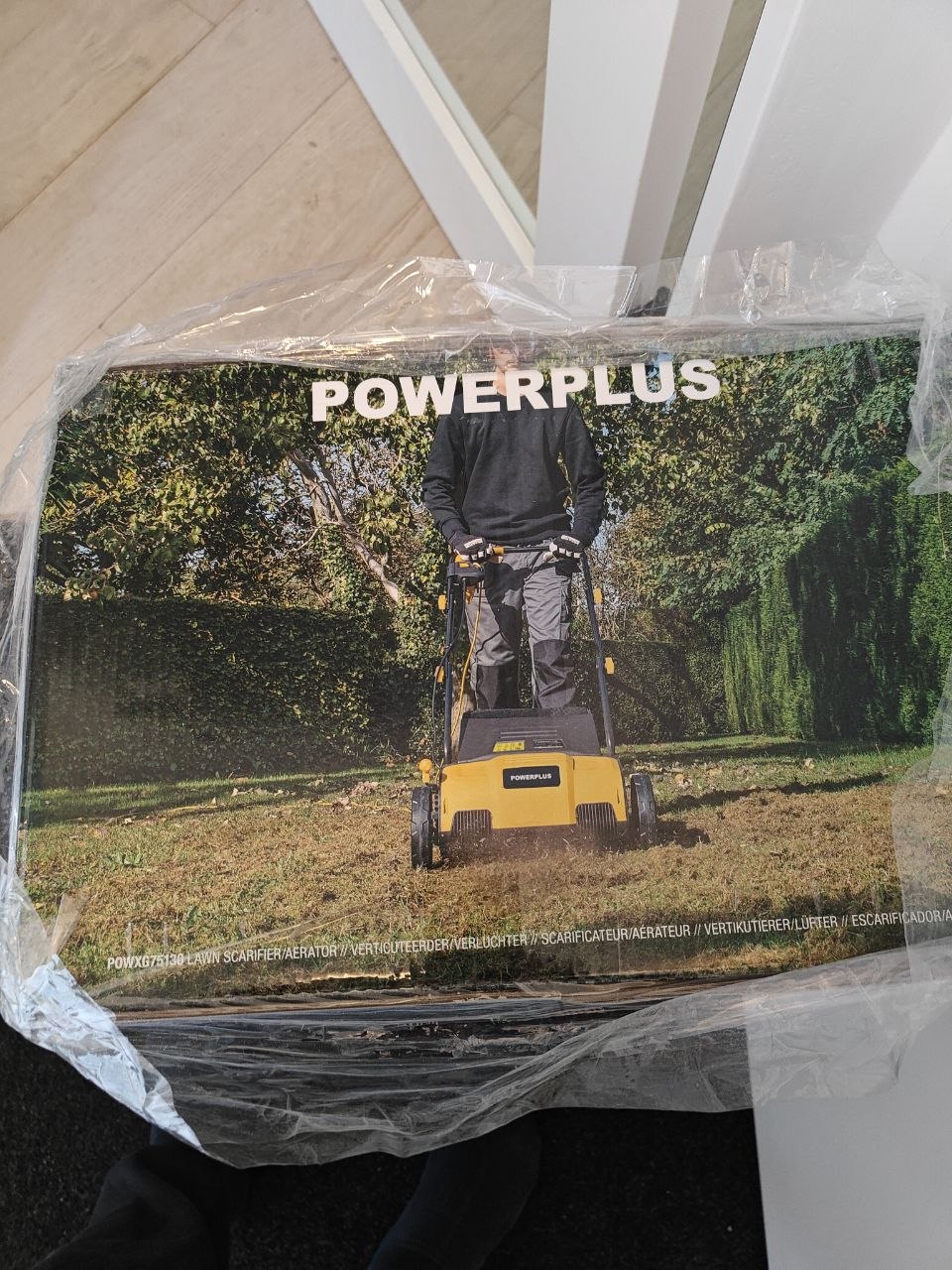
Either later today or tomorrow, I will use this piece of equipment to “scarify” my lawn before re-seeding it (my first time doing deep lawn maintainance). There is a lot of gardering planned for the next season.
❦❦❦
Physically and mentally, health is doing fine-ish. Sleep is going only so-so, but at last I found another line of investigation: it appears that my increasing muscle volume is the main reason why I experience issues with blood flow in my arms at night—a combination of hard(er) mattress and sleeping on my side. I will continue to experiment with the topic, but I fear the conclusion might be that I need to change my mattress. That would be frustrating: it is just four years old.
Spiritually, I am in the midst of a minor identity crisis, which started last week. (I am already sure that this will become a good story later, maybe even comical, but right now it gives me a lot to think about.)
This is, ostensibly, about the topic of cooking. As my internal story goes, I am supposedly good at cooking. I can follow recipes well, I understand a lot about food chemistry, I can discern tastes well, and I like to experiment. I also learned these things very early: as a young adult, I was faring genuinely far beyond average among my peers in the cooking department, to their delight.
The crisis came to be when I realized that most of my satisfaction with my skill only comes from the confidence that “I am at least as good as my mom was” (I learned from her, and perfected from there) and the memory that she was receiving a lot of praise for the quality of her food. If she was good, and I am better, I must be really good, right?
Well. I spent some time reflecting on my culinary experiences in the last few years, in particular the joy of sharing meals with my friends. Objectively, my friends’ cooking is really good. For the person I am today, my friends’ meals are in fact much more refined, interesting, pleasurable and healthy than most of what my mom ever cooked… or taught me! And even basic restaurant food is starting to feel advanced compared to what I can make for myself.
I then thought some more about what I routinely cook and serve when I’m hosting. Well. There is not so many ways to look at it. It is not great. It’s good, but not great. I am… behind, skill-wise? Or something like that.
The core problem here is that I was brought up in a family that wasn’t particularly rich and so our access to ingredients was limited. We were also socially isolated and so there was not so much culinary diversity around us. My mom did well with what she had access to, but it was just limited. The input she received also came from other folk whose own culinary expectations were low. And I mistakenly assumed that the high praise she was receiving was calibrated on a global scale. Then, feeling strong with my advantage in early years, I stagnated.
Where does this leave me?
On the topic of cooking, as a starting point I am still in the process of recalibrating my self-perception. I believe I am able+willing to accept that my cooking skills are, at best, average. It takes me far more effort today than my peers to achieve similar results, because they now have spent many more years of additional practice and refinement. It is not so clear I will want to “catch up” very soon, since I am currently prioritizing other areas of life, but at least I might gain some additional curiosity in that area.
The reason why this line of questioning on the topic of cooking blossomed into a minor identity crisis is that I started to wonder what else besides cooking is suffering from the same problem. In how many areas am I feeling falsely confident that being “at least as good as my mother” is objectively good enough for me? Gardening and plant care came to mind first, as well as keeping my home clean and organized. I am working on those currently. But I sense more areas will need the same scrutiny, including my literary knowledge, interest in history and geopolitics, my views on family bonds, my architecture preferences, my expectations about social engagement. Am I who I think I am?
❦❦❦
Ultimately, one of my values is to look at what people do more than listening to what they say.
This is why I registered to become a party member last year, and why I agreed to a significant time investment last month towards volunteering for my city’s council election campaign.
This was actually exciting and enjoyable! Most of the work was handing out fliers in various places and walking around neighborhood to talk with people at their homes, and holding stand at the town marketplace.
It felt rewarding, but we were also actually rewarded: our group was elected to receive one more seat on the council than four years ago. From 4 to 5 (out of 23), this feels like a major win.
As a next step, expecting to gain some further responsibilities in that area, I am now provisionally attending official training on the inner workings of the city administration. The organizational and management parts of the training feel rather basic, but the governance parts feel genuinely new (and useful). I love this opportunity.
❦❦❦
On the home improvement front, there were two milestones.
Given the high and raising energy prices, one topic that will need attention throughout the year is understanding how I consume electricity. As I reported last month, we currently can balance the cost of consuming electricity at night with the solar production during the day, but that will (legally) change next year. My next step after that will likely involve a combination of a battery with smart(er) scheduling of my device use but I will need first some data about actual usage.
To this effect, throughout March, I introduced power and energy use sensors.

Thanks to the new sensors, it’s now clear(er) how I will be able to reduce or move my electricity consumption through the day.

One specific device that requires additional attention is the heat pump. It is supposed to contain its own sensor but that does not work (and other users of the same model report the same). The device is wired directly to the breaker box, so for now I “make do” with this ring-based meter (top right in the picture). However, this measurement technology is very imprecise. In my case, it is under-reporting energy usage.
❦❦❦
I also worked through a more rewarding and just as important mini-project.
Ever since the window in my living room has become wider two years ago, a lot of sun is coming in. This feels nice in winter, but from March to September it becomes a problem: without care, the temperature inside becomes tropical and my plants suffer. There is a system to cool down the room, but it costs energy and does not fully offset the heat input. This is why, last year in spring, I placed shades with vertical slats that I can orient against the sun. This is effective.
However, the orientation of these slats is controlled with a small beaded cord. This became a major inconvenience last summer: at least two times per day, I had to come down to manually adjust between morning and afternoon (opposite sun directions). I love my plants, but this was just too much work.
This made me search for automation, and even consider building my own. However, I was not excited about the overhead of a custom design: this chart reminded me I would need to spend max 12 hours on it, otherwise it would not be worth it. I am not so confident about my hardware design skills.
Thankfully and serendipitously, I found an inexpensive small device that does everything I did not want to do myself:

This small servo-motor can be controlled remotely via Zigbee commands and can memorize the orientation range (0-100%).
The rest was “just programming” but Home Assistant makes it really easy [1]. I now see the shade orientation adjust automatically every ten minutes, and that feels very satisfying.
❦❦❦
Meanwhile, my “bootstrapped start-up life” is going more-or-less as I expected, and progress is being made, albeit slowly. One thing that happened last month is that I forked another small piece of my project into a standalone web app, Community Maps: it is meant to help (online) communities with placing each other on the map. You can read its story here.
The other thing that happened is that I am making steps to strengthen the structure around me that helps keep my work on track.
For context, ever since my local incubator program two years ago, I have practiced “intervision” with a small group. Intervision is a Dutch thing where entrepreneurs spend an hour every couple of months keeping each other accountable on their business and personal goals; somewhat like what an executive advisor would do in the US corporate world, but more egalitarian and reciprocal. My group is currently negotiating two extensions of this routine: one to create more regular touch points (weekly accountability) and another to also create knowledge transfer sessions.
Separately, I am also toying with the idea of organizing a meetup of similar-stage folk in my area, both as a community service to offer this structure to people who might currently miss it, and as a personal investment towards my local professional network. This project had felt nebulous when I first started thinking about it last November, but I feel I am now gaining clarity thanks to my new connections on the city council. Stay tuned.
❦❦❦
On the book front, I am currently finding it very hard to be curious about non-fiction. In hindsight, I remember I went through a similar phase last year at the same period, as well as the year before, so maybe I should just accept that the transition from winter to spring should be my time to enjoy fiction.
- Alexis Hall - Boyfriend material and Husband material
- A very sappy romance story between two British people with very different, almost incompatible personalities—hence the opportunity for a story. None of the characters felt relatable—British culture and especially humor is just too far from my own—and I was even frequently annoyed at them. The writing was all right though. As to why I persisted through the two volumes: probably the schadenfreude of watching a train crash in slow motion? I’m not sure.
- T.J. Klune - The House in the Cerulean Sea
- This one is genuinely good. Think “Neil Gaiman good” (theme, style, storytelling), without the stain from the author’s sins. It caught me in the feels multiple times. High chance of multiple reads.
❦❦❦
Regarding interstitial reading, as usual there was a lot to process and think about, and I’d like to share a few things. However, unlike previous months, this time I’ll batch them and start with the general thought patterns that they entertained.
❦❦❦
Thought: complexity in humans systems increases by an order of magnitude at each layer of delegation. Simultaneously, velocity at every layer is largely bottlenecked on messy human interactions across organization boundaries. Most of the “AI industry” is currently working to trim the bottom layer and internal bottlenecks. It doesn’t really address velocity bottlenecks “at the edge” so we can’t reasonably expect more than a limited impact on velocity (and thus global economic output) at a high level. Amdahl’s law applies.
Corroborating:
- Every layer of review makes you 10x slower by Avery Pennarun, CEO of Tailscale. A short piece that reminds us what time scales are involved at every level in an org. Matches my experience.
- Verification debt: the hidden cost of AI-generated code by Lars Janssen. The title says it all, but there is nuance. I learned a few things.
- The hidden danger of shipping fast by Cleo Pleurodon, product person at PostHog. This is good distilled operational know-how, probably applicable to my project, so I’ll revisit.
- AI still doesn’t work very well, businesses are faking it, and a reckoning is coming, an interview of Dorian Smiley, co-founder and CTO of AI advisory service Codestrap by Thomas Claburn. Here, too, the title says it all, but I also liked that the interviewee’s opinions were developed across multiple organizations.
❦❦❦
Thought: “While one woman produces a baby in nine months, you can’t ask nine women to produce nine babies in one month.” That’s how I taught that IPC (Instructions per Cycle, a measure of throughput) and CPI (Cycles per Instruction, a measure of latency) are not simply the inverse of each other. Incompressible latencies and inter-dependencies between operations are throughput killers even in the face of massive parallelism. Likewise, we cannot expect that the reported decreases in project duration (latency) from LLMs will necessarily translate to a higher overall rate of successful projects. This is related to the point above.
Corroborating:
- Thoughts on slowing the fuck down by Mario Zechner. The author is warning up of hidden piles of unhandled complexity, which is likely to slow us down even more later.
- Some Things Just Take Time by Armin Ronacher. The author reminds us that business success also depends critically on relationship building with customers. Salient quote: “Nobody is going to mass-produce a 50-year-old oak. And nobody is going to conjure trust, or quality, or community out of a weekend sprint.”
❦❦❦
Thought: we are currently witnessing a great tension (ideological war?) between people who fear LLMs will rip their work off and kill all the jobs, and people who are optimistic LLMs will make societies better by reducing rent-seeking and proprietary divides. This tension is happening at a similar societal level as the right/left divide in politics, but it’s a different divide.
Corroborating:
So where are all the AI apps? by Alexis Gallagher & Rens Dimmendaal; in a nutshell, we’re not seeing all the presumed LLM-enabled work being published in the open.
The Cognitive Dark Forest by an author whose first name is “Janko” - creates a parallel between the Dark forest hypothesis and the dynamics inside the software industry: people hide their work because they might believe there’s a risk of economic annihilation if they are open about it.
AI Agents Could Make Free Software Matter Again by George London. The thesis here is that LLMs will transfer economic power from an elite of technology makers towards the general public.
Filesystems are having a moment by Daniel Madalitso Phiri. I strongly agree with the technical argument. Salient quote:
“Filesystems can redefine what personal computing means in the age of AI. […] In the sense that your data, your context, your preferences, your skills, your memory — lives in a format you own, that any agent can read, that isn’t locked inside a specific application. [..] This is what personal computing was supposed to be before everything moved into walled-garden SaaS apps and proprietary databases. Files are the original open protocol.”
The Last Gasps of the Rent Seeking Class by George Hotz. This is a bit more of a poorly-argued hot take, but the reading between the lines aligns with my own: that the big players (OpenAI, Anthropic etc) will have a hard time keeping their moat, a lot of players in the SaaS industry too, and maybe that’s a good thing.
❦❦❦
Thought: the time is coming to collectively develop a social etiquette around LLM usage.
Corroborating:
- Stop Sloppypasta by Alex Graber
- AI Manifesto by Noëlle van Dijk
- Personal AI Ethics by Simon Willinson
I feel that all these three pieces complement each other. I also believe strongly that the best time was yesterday for us to systematically set up this type of document as shared cultural expectation when leading communities and organizations.
❦❦❦
Thought: the narrow focused people who were using their role in the tech industry as a mechanism to translate their special interest into a minimum amount of social respect without investing in social skills or an otherwise balanced life are currently hurting deeply and will need help to transition.
Corroborating: You Are Not Your Job by Jacob Young.
❦❦❦
Thought: the posers who were coasting in (or considering) the tech industry for easy access to money at minimum effort are now reconsidering. Good riddance.
Corroborating: What Young Workers Are Doing to AI-Proof Themselves (archive link) by Rachel Wolfe and Te-Ping Chen.
❦❦❦
Moving on to miscellaneous recent world news with potential great impact. This still deserves the previous format.
- Good(ish) news: Silicon Valley’s “Pronatalists” Killed Remote
Work. Then the Strait of Hormuz Brought It Back
by Dave Deek. The overall argument is articulated like this:
- remote work helps increasing birth rates. (evidence-based)
- we collectively should want higher birth rates worldwide, so remote work is desirable. (ethical thesis)
- there’s an alleged elitist cabal who doesn’t want everyone to reproduce equally, so they “killed” remote work to prevent that (that part, I’m not sure I agree with!)
- regardless of #3, Asian countries are now introducing remote work in reaction to the war, so maybe we’ll get higher birth rates after all.
- Good news: Germany Mandates ODF for Public Administration in Sovereign Digital Stack reported by Bobby Borisov. For context, there is currently a buzz throughout the EU regarding perceived excessive dependence on US tech. Many people are taking action, but the changes will become visible more slowly. This is a part of that.
- Intriguing news (good or bad? Yet to be determined.): The Treasury just declared the U.S. insolvent. The media missed it by Steve H. Hanke and David M. Walker. This is a bit of insider baseball, but in a nutshell by modern accounting standards if the US was an organization this year is when we could start considering it unable to pay its debts.
- Intriguing news, likely very good: Iran war energy shock sparks global push to reduce fossil fuel dependence, reported by Anna Hirtenstein and Kate Abnett. Anecdotically, I am seeing this all around me. It’s going to be painful, but possibly less than waiting for a global climate catastrophe.
❦❦❦
Some lighter weight fun to finish: Kagi has published this tool to translate between plain language and LinkedIn jargon. It works both ways and it is delightful.
❦❦❦
References:
- Rendall Munroe, Is It Worth the Time?. April 2013.
- Community Maps, Q10E Labs. March 2026.
- Raphael Poss, Community Maps: the story. March 2026.
- Alexis Hall, Boyfriend Material. 2020.
- Alexis Hall, Husband Material. 2022.
- T.J. Klune, The House in the Cerulean Sea. 2020.
- Wikipedia, Amdahl’s law.
- Avery Pennarun, Every layer of review makes you 10x slower, March 2026.
- Lars Janssen, Verification debt: the hidden cost of AI-generated code. March 2026.
- Cleo Pleurodon, The hidden danger of shipping fast, PostHog newsletter. February 2026.
- Thomas Claburn, AI still doesn’t work very well, businesses are faking it, and a reckoning is coming, The Register, March 2026.
- Wikipedia, Instructions per Cycle.
- Wikipedia, Cycles per Instruction.
- Mario Zechner, Thoughts on slowing the fuck down, March 2026.
- Armin Ronacher, Some Things Just Take Time, March 2026.
- Alexis Gallagher & Rens Dimmendaal, So where are all the AI apps?, Answer.AI, March 2026.
- Janko, The Cognitive Dark Forest, Rye Lang. March 2026.
- Wikipedia, Dark forest hypothesis.
- George London, AI Agents Could Make Free Software Matter Again. March 2026.
- Daniel Madalitso Phiri, Filesystems are having a moment. February 2026.
- George Hotz, The Last Gasps of the Rent Seeking Class, February 2026.
- Alex Graber, Stop Sloppypasta. March 2026.
- Noëlle van Dijk, AI Manifesto. February 2026.
- Simon Willison, Personal AI Ethics. August 2023.
- Jacob Young, You Are Not Your Job. March 2026.
- Rachel Wolfe and Te-Ping Chen, What Young Workers Are Doing to AI-Proof Themselves, WSJ. Archive link. March 2026.
- Dave Deek, Silicon Valley’s “Pronatalists” Killed Remote Work. Then the Strait of Hormuz Brought It Back, Governance Cybernetics. March 2026.
- Bobby Borisov, Germany Mandates ODF for Public Administration in Sovereign Digital Stack, Linuxiac. March 2026.
- Steve H. Hanke and David M. Walker, The Treasury just declared the U.S. insolvent. The media missed it, Fortune, March 2026.
- Anna Hirtenstein and Kate Abnett, Iran war energy shock sparks global push to reduce fossil fuel dependence, Reuters, March 2026.
- Kagi, LinkedIn Translator.
Footnotes:
| [1] | The configuration used to orient my sun shades: - variables: target: >- {% set az_sun = state_attr('sun.sun', 'azimuth') | float(180) %} {% set az_window = states('input_number.sunshade_window_azimuth') | float(157.5) %} {% set relative = az_sun - az_window %} {% set power = states('sensor.ecu_216000298129_current_power') | float(0) %} {% set threshold = states('input_number.sunshade_power_threshold') | float(1000) %} {% if power <= threshold %} {# Insufficient solar power (cloudy, overcast, etc.) #} 50 {% elif relative < -90 or relative > 90 %} {# Sun is behind the building (>90° off window normal) #} 50 {% elif relative <= 0 %} {# Sun east of window normal: 50% → 0% #} {{ ((-relative / 90) * 50) | round(0) | int }} {% else %} {# Sun west of window normal: 100% → 50% #} {{ (100 - (relative / 90) * 50) | round(0) | int }} {% endif %} # Send to shade motor - action: cover.set_cover_position target: entity_id: cover.bg_wk_zon_a data: position: "{{ target }}" |