January Update
At the start of January, a “snowpocalypse” happened in the Netherlands. As 30cm (~10in) of snow fell over two days, people, cars and trains stayed home. Most planes did too. The airport ran out of de-icing fluid.
It was rather pretty, though. It made me happy.

Snow in the village.
❦❦❦
Soon afterwards, I headed to NYC.

Sunset at JFK. My first sunset there ever.
As usual, there were people to meet and work to do. A lot of quality time with friends too. Ate super well. Went out in Hell’s Kitchen. This too made me happy.

❦❦❦
Although I had planned to stay nearly two weeks in NYC, just before my trip I decided with a group of friends to divert for an impromptu long weekend vacation in Montreal, Canada.

It was cold.
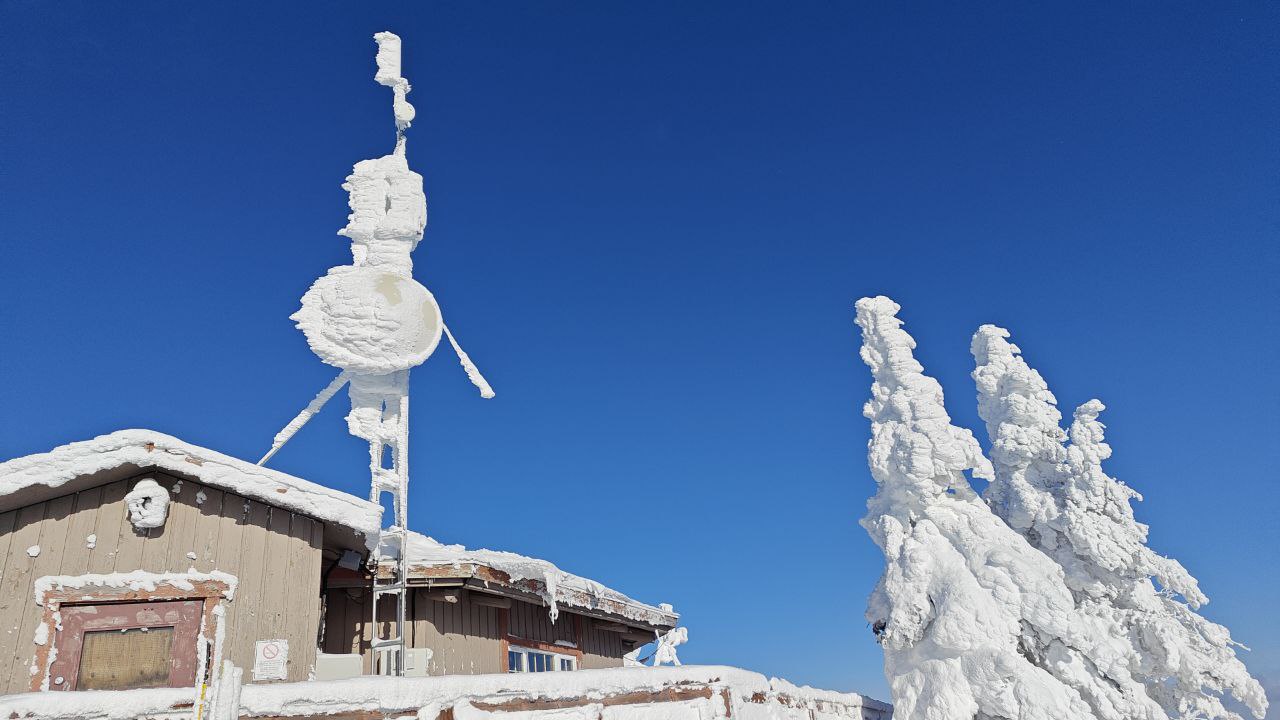
Very cold.
It was my first time at Mount Tremblant (QC). The snow quality there is much better than further south in the US. The temperature was frigid; I felt ill-equipped. However, the snowboarding was glorious and we enjoyed ourselves (more on this below). I was rather happy.
Sadly, Winter Storm Fern cut our holiday short and forced us to travel home earlier than planned.
❦❦❦
One highlight from the month was our dinner at the village next to the mountain on Jan 23. We enjoyed the right combination of delicious food, good conversation and comfort with each other’s company.
This is when I explained to my group the concept of unitary experiences: things that you might want to happen multiple times, but which in all likelihood only happen once in your life.
Contrast those with routines or traditions, when you never quite know when will be the last occurrence; and unremarkable experiences that do not feel worth repeating.
Unitary experiences are all around us; but it takes quite some life-years to start noticing them. Indeed, in early life, all experiences feel new and we do not always understand how we feel about them on the moment. It is never quite clear whether an experience is truly valuable, nor whether it is the first instance of a sequence. It takes more life time to learn to recognize that an experience matches something we desire, and that it is unlikely to occur again.
Once understood, I find unitary experiences to be effective at teaching us about the fleeting nature of life and how to be more grateful for the moments we share together with those we love.
Snowboarding and dinner in Quebec with that particular group of friends was likely a unitary experience. In hindsight, I also realized that all my snowboarding vacations in the past were also unitary in that way. This made all of them special memories that I continue to cherish. In comparison, I also sometimes think about the way some people “do” vacations, by returning year after year to the same place, going through the same activities, the same feelings, just growing old together. Is this something I would enjoy? I’m not sure.
❦❦❦
Something that happened after I returned back home is that I had to drive a bit more than usual on account of my electric scooter needing repairs. The reason why it’s worth mentioning is this:

Five digits changed at once.
Amidst a ten-minute drive, I saw the odometer jump from 169999km to 170000km. Not quite a unitary experience as discussed above, but still a rather unique happening. Even though odometers change value all the time, five-digit changes are not too frequent for a single vehicle, much less for the same vehicle/driver pair, and probably rather rare when adding the requirement that the driver pay attention to the counter at that very moment. Before it happened, I would never have expected that this would be something I’d pay attention to; now that it has happened, I can’t say I will ever pay attention to something like that ever again; and yet, I am still happy at the memory that I was there and paying attention at that particular moment.
I wonder what are the other unimportant experiences of life, like this one, which are not worth remembering but still make us happy in the moment.
❦❦❦
Unrelatedly, I’ve been wearing this super cheap hat for a while now. Its quality is garbage but it is very comfy. Because it’s so cheap (<10€), in the past when it was broken or lost I would just buy a new one of the same model.
This month, the lining was damaged. Then, in a life first, I became annoyed at myself for thinking about this hat as a “cheap thing”, feeling instead that it deserves more care because it’s just so comfortable and I don’t know how long I will be able to find replacements. So I fixed it instead.
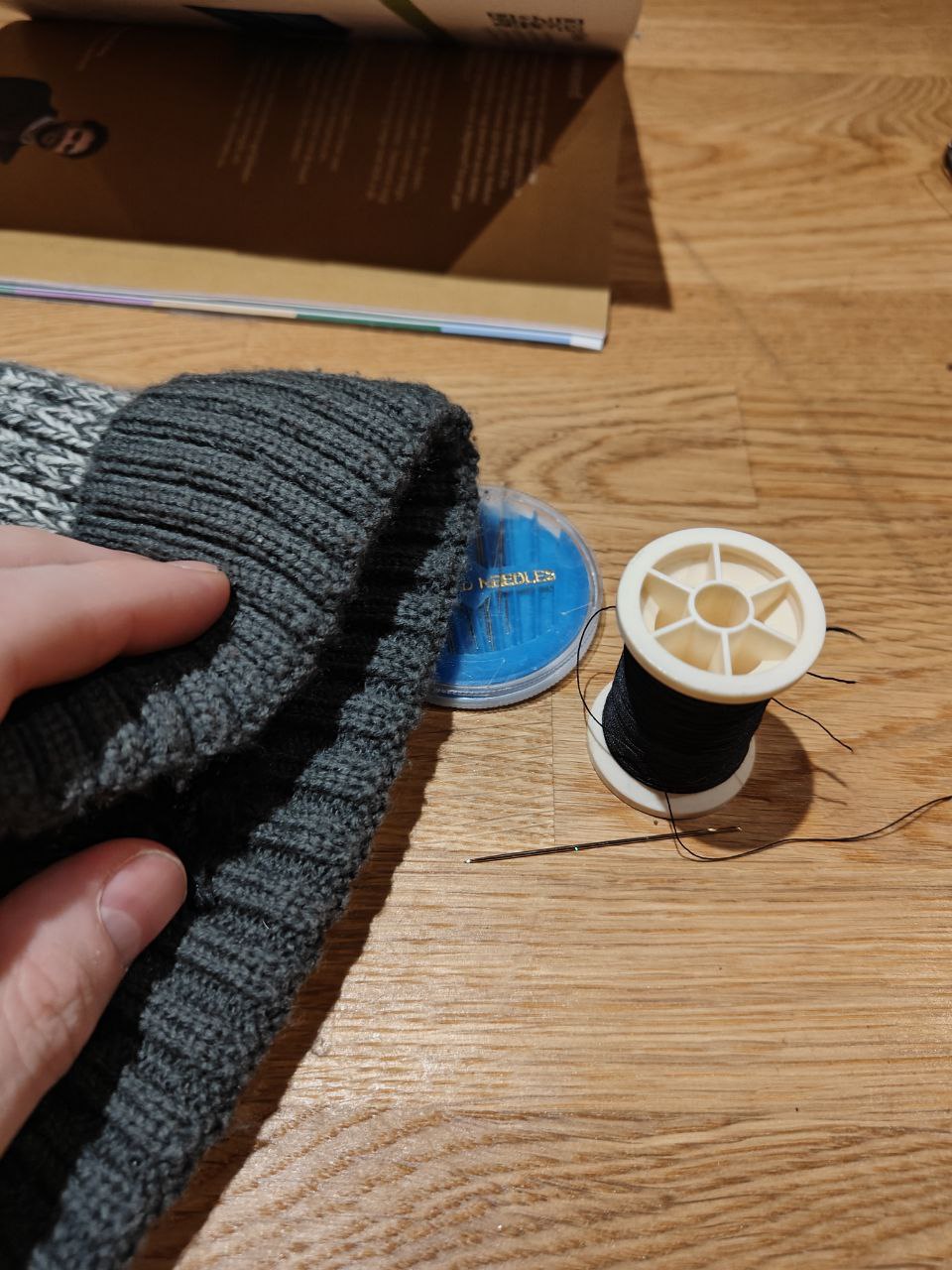
Fixing an old hat.
❦❦❦
As you were reading the above, you probably sensed there is some underlying pattern here. Even though I was merely writing to comment on my camera roll, I am sensing the pattern too. Reflecting on ephemeral experiences, paying attention to the little things because of uncertainty about whether they will happen again, etc.: these are the movements of a mind concerned about mortality.
A naive connection here would be to link this train of thought to my recent visit to my mom—this the last main thing that happened last month, I was back just yesterday. However, I do not think that is the right connection (I have a better theory, see below) but it is worth spending a few words on the topic nonetheless.
She had transitioned to a nursing home a bit more than a month ago; it was my first visit to her new residence. Objectively, her situation is much better overall now than it was just two months ago: her physical health is doing better, she receives much higher and frequent care, and she sees people every day after having stayed nearly alone at home for six months. Emotionally, things are still difficult. She always had troubles with anxiety due to unprocessed traumas in her youth, and used to manage that with tobacco, but she stopped smoking completely when she moved to the new place. (She did this without telling her doctors, so the new place did not know about her previous addiction nor did anything to help her with kicking it off. It must have been painful.) So her anxieties have been flaring up. She is now receiving treatment for that too, and there will be a counselor/therapist on-premise starting next month.
Another development is that she is more visibly losing her memory. She started to confuse me with other family members, and refer to our previous currency before the introduction of the Euro. In other moments, she is fully lucid. I am confused about how I feel about this, and how I feel about her overall. Despite these changes, it seems that I am emotionally detached, somewhat quiet even, and definitely not alarmed. Is this relative calm because I have studied the aging process before and prepared myself? Is this the fruit of a successful meditation practice? Or is it just basic emotional shielding? Time will tell.
The final thing that happened is that I got angry at the state of modern technology. My mom used a smartphone to remain in touch with her network. The UI on that is just extremely difficult to use by a person who can’t comprehend more than 3-4 things happening at once (there are way too many items on the screen) and who can’t apply steady pressure with their finger on a single point on the device (tremors). The part that infuriates me is that none of this technology is sufficiently open that I can modify its UI or create a different “skin” to simplify its appearance. And there are no alternatives! (Believe me, I searched. A lot.) We had fifty years to figure out how to make a device that helps the elderly to quickly and easily reach out to their family, and not only did it not happen, we actually regressed in our ability to build this because communication technology (all layers) is more locked down today than it used to be before. This sucks and I’m sorry for it.
❦❦❦
So, if not the topic of my mom, what then is causing this unusual color in my commentary above?
Three overlapping narratives may have explanatory power here.
Tomorrow, I will be celebrating a very special anniversary. It will be exactly twenty years since I implemented my decision to stop being unsure about where I would be living next. All the phases of my life prior were defined primarily by relatively frequent and disruptive moves across countries, outside of my control; at the time, I knew no other way to live, and I knew no notion of a “stable home”. So one of my first life altering, major moments in early adulthood was when I decided that it would be valuable for me to learn how to stay put in one place for a longer amount of time and build a home. It has now been twenty years since I started implementing that, and so the coming year will likely be colored by reflections on how this choice has served me.
Another story is that barring major medical advances, statistically I can now be certain that I have more calendar life-years in my past than in my future. In the past, I expected to be distraught when this realization would hit. Today, it feels OK. There are two mitigating factors here. One is that I am objectively much more healthy in all domains (physically, emotionally, spiritually) than at any point before in my life. I would not trade that for more of my earlier years under any circumstance. The other factor is that the first twenty years of my life do not evoke any memory I would want to cherish, nor did they bring any good learning experiences; I feel my life only really started around calendar age twenty-three. After offsetting my calendar scale accordingly, statistically my future might still remain longer than my past. Yet, consciously processing these life mathematics bring about a stronger realization that life-altering accidents can happen at any time. Reflecting on how I have been unlikely lucky with health and other things so far makes me more grateful for the little things of everyday life.
The last story is actually much warmer and upbeat. Some time in 2024, I started noticing new emotional urges: that to nest and nurture. The trigger (and enablement) was likely my house project; never before had I been pushed so hard to design a living space, and so probably that exercise awakened several latent desires.
The urges started with little things, for example back when I felt warm and fuzzy inside when a new member of my sport club reached out to learn new stuff from me, or when I gave an opportunity to an inexperienced salesperson to be enthusiastic about their snowboard products. My ongoing participation to an online community (the one I’ve referred to multiple times recently) is also part of this story arc.
And so what has been happening more frequently since mid-2025 is that I started more consciously thinking about my projects and experiences as opportunities to 1) build shared experiences together with people I care about (instead of just “not being alone”) and foremost 2) frameworks that I can offer to other people where they can discover stuff about themselves, each other and the world.
Since then, I have started to contemplate the stuff I go through in terms of what I can share and how it can serve as foundations for future shared experiences. It really feels like looking at life through a differently colored glass.
❦❦❦
A related aside, since that connection is probably obvious as well.
Raising children? Still a hard no for ages 2-8. My physical and emotional health would suffer too much. Ages 12-18? Probably no for practical reasons; I don’t think I can afford to do it well: I can’t afford it with my current budget, and I could probably figure out how to increase the budget but it would cost me quality, non-rest time I’d rather want to spend with the person. Older? Maybe. I have been dreaming about it more frequently recently. I also might be open to joining forces with a parent who started earlier already. But no action planned at this time yet.
❦❦❦
Switching gears; another unrelated thing that happened was the publication of a heat insulation guide by my town council. Thanks to the connections I fostered last year in my town politics, I was selected to give an interview about my project and it ended up the first of the three published “showcases”. The rest was generic technical recommendations, but still, it’s a start: probably the first time my work and my face are distributed in print to >10.000 locations and >20.000 people.
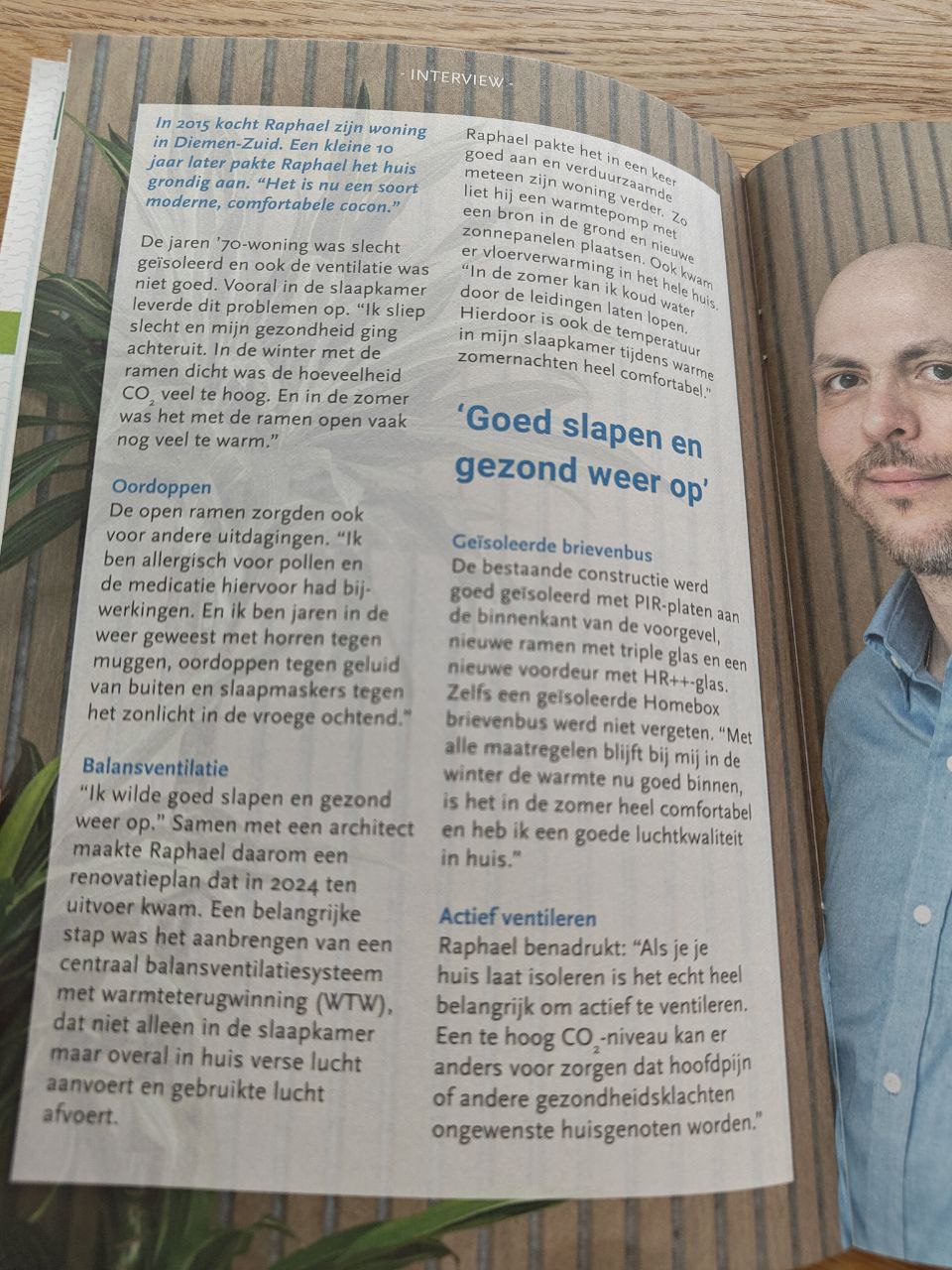
Article about heat insulation in your home.
In other news, the local municipal elections in my country will happen next month, and we are starting to work on the campaign. So far, what I found most interesting was to witness the internal discussions between folk who want the local team to campaign on its own merits, and those who want to ride the wave of the national success. On the one hand, it probably will help locally that my party (D66) received an unexpected large boost in the national elections last November; however, on the other hand, they are also currently trying to form a minority government, and so there’s a non-zero chance they will collapse prematurely through a vote of no-confidence before the March election—and this would negate all the boost from last year. The local campaign needs to work with this uncertainty; for me, this is interesting because no amount of rational math and prior expertise provides me with useful handles here, and so this will call for new skills and lessons.

❦❦❦
Furthermore, as usual I have a sizable list of bookmarks of stuff I’ve read about and thought about sharing here.
This time however, when it comes to LLM-related news, I just can’t. I feel saturated somehow? The main three points that stuck out:
- a lot of people talk about how LLMs impact how they work, but nobody really talks about how LLMs helped them finish anything. I’m also not seeing all the big news we are told to expect about groundbreaking projects being completed thanks to generative AI. If the generative AI is really supposed to help everyone, with everything, all the time, where is the proof? I feel tired to think (and write) about all the potential consequences. I want to focus on stuff that completes & contributes to the world.
- instead, a bunch of rich people are paying big money (and burning a lot of energy) to have thousands of computers use the new LLM tech to generate random bits and send them to each other, to construct what appears to be a giant, piece of evolving “art”. Meet Moltbook. I gagged twice. First at the sheer waste of resources (I have nothing against art per se, but I object to spending so many resources after the artistic point has been made already). Then I gagged also when I realized how many people think that this… thing… is something “special” that somehow might demonstrate that something momentous is happening in the world. But there isn’t? Just rich people burning dollar bills in public while other people go hungry. It’s obscene.
- there is So. Much. Noise. about how generative AI is going to “replace” stuff. Read again everything that I shared above today. Nothing in there is even remotely a candidate for something that generative AI could possibly impact, let alone replace. I think I am tired of giving water to the mill of the mass of folk who can’t look around them and realize how many important parts of their life happen outside of computers and are relatively immune to technological development.
That said, I did have fun harping on the metaphor of “the hungry ghost trapped in a jar”, so maybe I’ll do more of that (later).
I’m also still moving forward with my side project. Currently working on a back-end layer to support a multi-user product demo. Progress is slow, but that’s all right, because other things are happening in my life too.
I also had fun extracting one of its sub-sub-sub-projects into a standalone mini-application which you can find here: https://ad-freedom-grade.q10elabs.com/
❦❦❦
Meanwhile, there were some non-computer news that I felt worth paying attention to.
One thing I’ve read is this analysis of the oddities on the stock market last month (some popular computed numbers did not go up the way they were expected to as a result of companies being more profitable than expected). The theory there is that the previous long period of “numbers go up” was powered by the commitment of the Japanese government to an artificially low central bank interest rate and this is now suddenly changing. I’m not sure I buy it the theory yet, but it pushed me to research how institutional investors leverage one country’s guarantees to generate profit elsewhere.
Another thing is that a Chinese lab was able to build a big machine that converts heat to electricity (a power plant) using supercritical CO₂ to move the heat around instead of steam. It’s actually producing real grid electricity already. This is a big deal, because all steam-based plants (regardless of fuel: coal, gas, nuclear, etc.) pay an efficiency loss due to the friction of the water moving around, and supercritical CO₂ avoids that. There is a scientific article that explains this and I also found a nice explainer video. Supercritical CO₂ is also better at moving heat around, so they were able to reuse leftover heat from the nearby steel plant as energy source which is also a first.
I also found this article on Chinese energy infrastructure. The text is light on details, but the pictures are breathtaking.
In related news, solar and wind energy supplied more power than fossil fuels throughout the EU in 2025, for the first time ever since the industrial age started. It’s also a trend so it’s likely only going to get better from there.
❦❦❦
Perhaps the article that most impacted the way I think is the meta-analysis Recent discoveries on the acquisition of the highest levels of human performance by Arne Güllich, Michael Barth, David Z. Hambrick and Brooke N. Macnamara (PDF here). Its main finding:
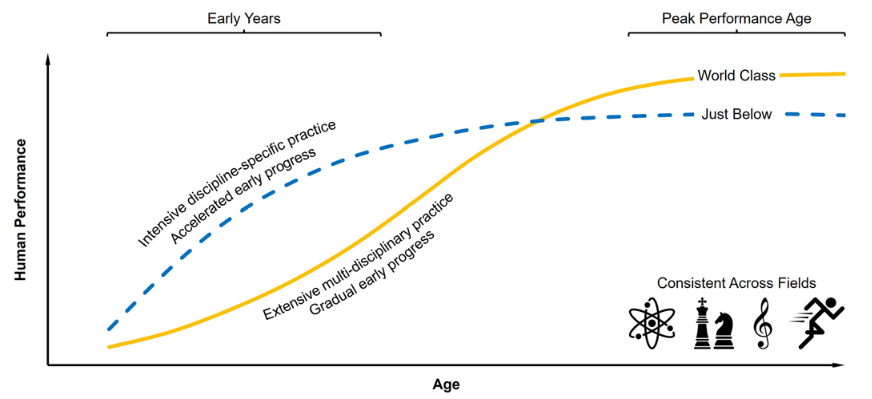
“The development of the highest levels of human achievement. Across domains, world-class performers, compared with peers performing just below this level, engaged in more multidisciplinary practice and showed more gradual performance progress through their early years.”
The two takeaways:
- people who are good at what they do in youth become good by focusing on one thing and staying focused. In contrast, people who become good at what they do later in life become good by being multidisciplinary.
- people who are good at what they do in youth eventually plateau, at a lower level than people who become good later in life.
Really, the detailed findings are definitely worth reading with some attention. This is top-notch science.
❦❦❦
References:
- NRC Handelblad, KLM had ineens te weinig glycol om vliegtuigen te de-icen. Wat is glycol voor middel?, January 2026.
- Musical Mondays at Rise Bar, NYC.
- Wikipedia, Winter Storm Fern.
- Wikipedia, 2025 Dutch general election - polling results.
- Wikipedia, Minority Government.
- Q10E Labs, How “Ad-Free” are you?.
- OccupyWallSt, The Great Unwind: Anatomy of a Silent Liquidity Crisis.
- China’s “International” Center for Science and Technology Innovation, Major CO₂ power generator starts operations, December 2025.
- Qinghua Deng et al., A review on supercritical CO₂ and CO₂-based mixture in power cycle, Energy Conversion and Management Vol. 324, 2025, DOI 10.1016/j.enconman.2024.119295.
- Anton Petrov, The End of the Steam Age? China’s Breakthrough CO₂ Generator.
- Tim Appenzeller, The green giant - Images of China’s clean energy infrastructure reveal a transformation of unmatched scale and speed. Science vol. 390, 1210-1221 (2025). DOI 10.1126/science.aee8001.
- Beatrice Petrovich, European Electricity Review 2026, Ember Energy, 2026.
- Anne Güllich et al. Recent discoveries on the acquisition of the highest levels of human performance. Science vol. 390 (2025). DOI 10.1126/science.adt7790.