December Update
The common thread for December was to put to work certain skills and ambitions that had been brewing for the last year.
❦❦❦
The first was the creation of this dashboard:
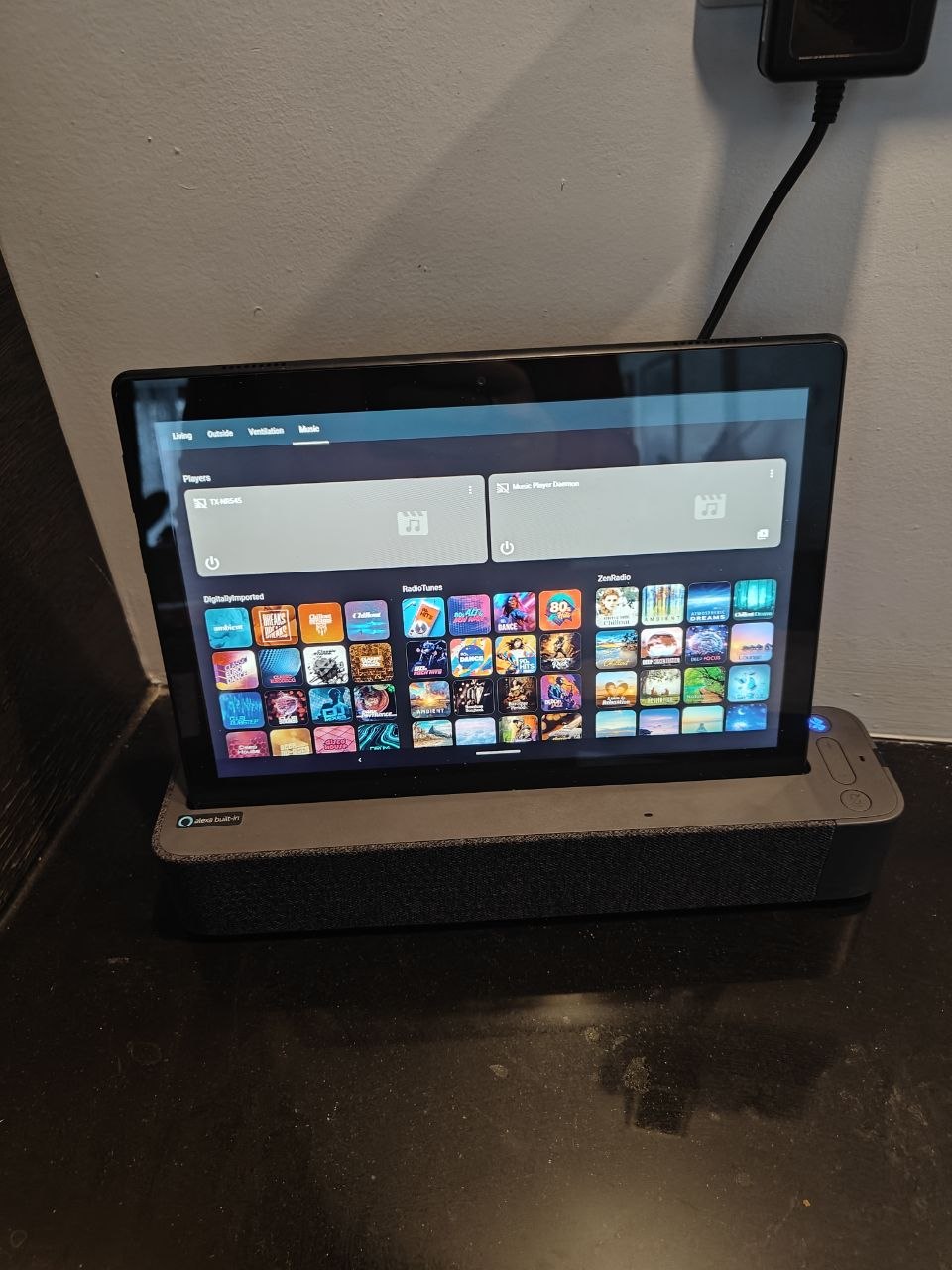
Music radio channels.
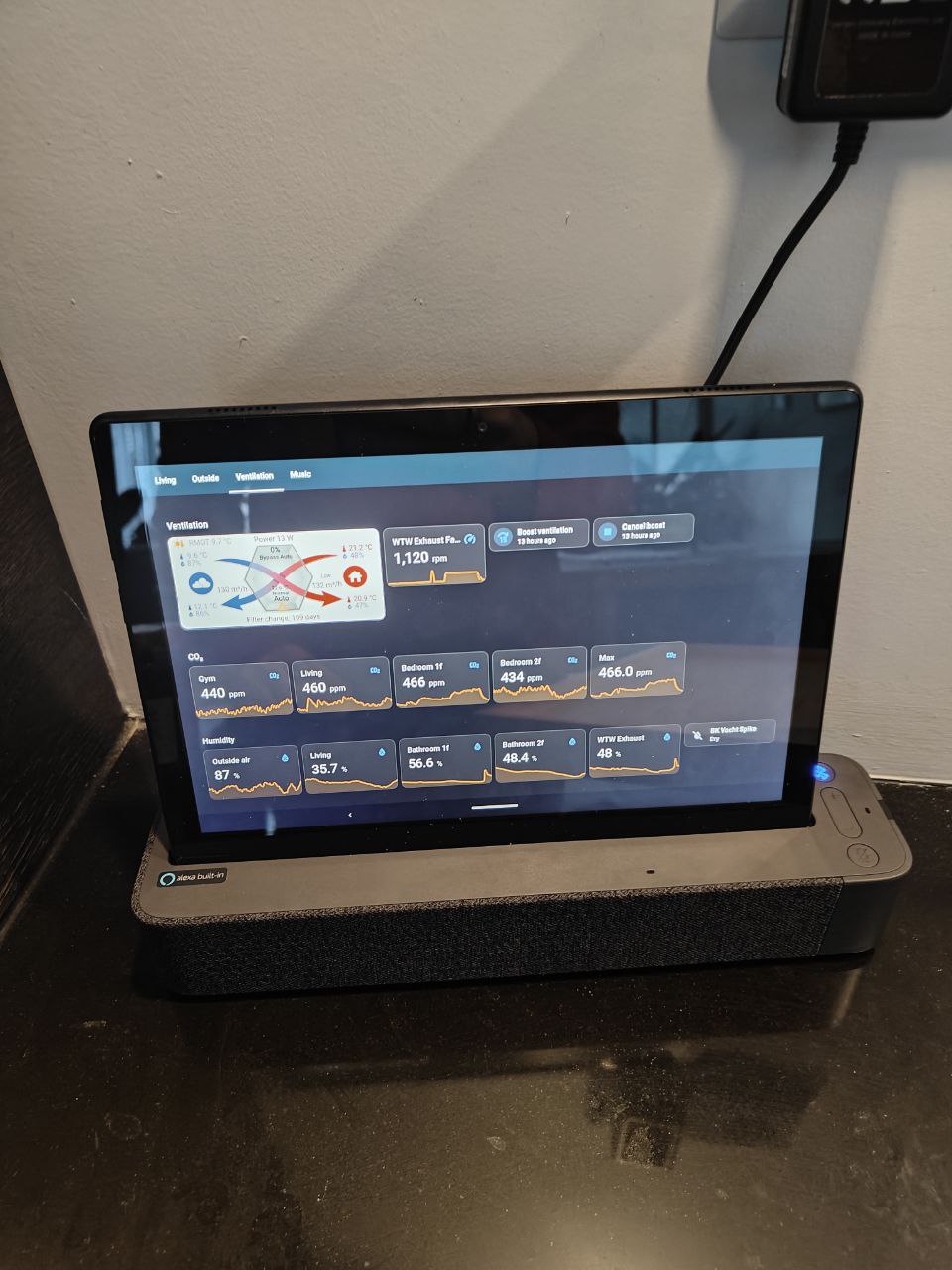
Ventilation and air quality overview.
What you see here is a cheap Android tablet displaying a Home Assistant (HA) dashboard in “kiosk” mode.
For context, HA is a software platform for home automation—think Google Home or Alexa, but that you can run on your own computer inside your home, and which doesn’t require an internet connection.
I have been using HA for the last two years: it started as a way to program turning lights on automatically during evenings while I am traveling, and gradually took on more and more responsibilities. Its most important functions currently are to drive my ventilation in proportion to CO₂ concentration and bathroom air humidity, and to keep track of the cycles of my heating system so I have data available in case of faults. (It also tells me when my printer ink levels are low and which days to put the trash out, and a bunch of other things.)
Overall, I consider HA to be a quiet augmentation for my living space, with few visible touch points on my daily life. There is a mobile app I use to control it, but it is not open often. I do not consider it a hobby.
However, I have learned to achieve many things with it, and lately some friends have been pointing out that my current setup is worth showing off, for their benefit more than mine (curiosity). This is why I acquired a cheap secondhand Android tablet, and spent a day or two to tell it how to expose some of my HA features as a “dashboard”. Initially, I was not so clear about how this gadget would help me, but after a few weeks I have learned to appreciate the clearer trash pickup announcements and outdoor climate details.
❦❦❦
The next thing that happened is this holiday investment:
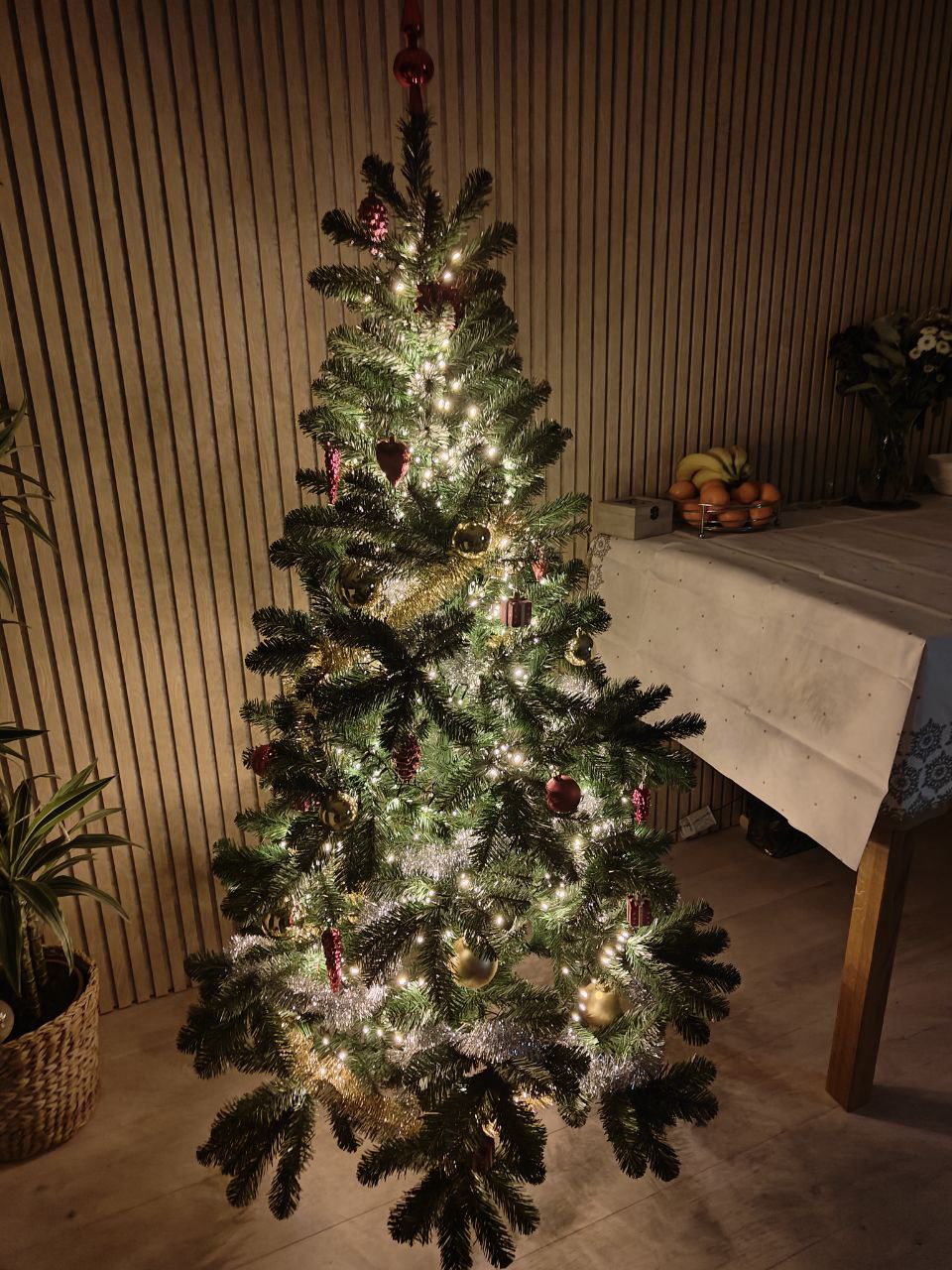
Tree with lights and miscellaneous hanging objects.
This is by far the most incongruous thing that happened to me this year. I was in the process of organizing an event (more on this below), when a mix of a thought and a feeling struck me sideways: in alignment with my choice to invest more into rituals this year, it seemed appropriate to support that with a tangible symbol.
For context, I have been living on my own since my late teenage years, and in all the years since never once arranged my home in celebration using a tree. I have consistently found traditional “christmas trees” undesirable: they are a symbol of Christian extermination of past pagan practices, a symbol of modern consumerism, and used to remind me of unpleasant memories, that of a stressful period in each year of my childhood. Within this context, a tree does not make sense at all.
What changed recently is that I have become a more active believer of the importance of defining one’s own traditions and symbology.
One factor that pushed me is that I was already fond of the winter solstice around Dec 20, both to celebrate the start of winter (one of my favorite seasons) and as a period where I can reliably organize get-togethers with friends: they are already less busy with work and not yet allocated to their family holiday. I really enjoy the period of anticipation ahead of the solstice, and a tree with lights feels like a good symbol for it.
The other factor was a realization that I needed some environmental help. Through the last ten years, I have been using this period to rest and give me a new impulse into the new year. One thing that happens in the second week of rest is that I get bored and tend to keep myself busy by directing my attention to things that do not belong to rest (such as, a bit of work). I decided to experiment by keeping the tree lit and decorated throughout the period as an ostensible reminder of my commitment to rest.
In hindsight, I confirm that the tree enhanced my enjoyment of the anticipation pre-solstice, and the quality of my rest post-solstice. So I would say it was a success overall. The experiment needs more data though, so we will pick that thread up next year.
❦❦❦
Another thing that happened was that I organized a somewhat larger event around the solstice.
I am no stranger to organizing things with people; yet, it had been many years since I last had more than ten guests inside my home. Back when it happened semi-regularly, more than fifteen years ago, I over-exerted myself while organizing, and my therapist and I eventually concluded that this activity was not aligned with my emotional well-being. But that was fifteen years ago! Many things have changed since, including me. My boundaries and limits are clearer now, and I have gained quite a few skills towards sustainable event organization.
The main unblock was to rely on a catering business for food, one which I had already sampled during a previous event. I also rearranged furniture to allow more free flow movement, and asked guests to feel comfortable with self-serve for both food and drinks.
Pverall, it went smoothly, even though with nearly twenty guests I probably reached the capacity of my space. It was also a new mix of social circles and so emotional intimacy was low on account of folk still getting to know each other. I feel that I might prefer a smaller, more intimate group for my next winter event, and keep the more bubbly and diverse crowds for my spring or fall events. (Yes, there is a half-baked plan to make this a quarterly occurrence. I am still figuring out the details.)
❦❦❦
There was another somewhat incongruous development: I made Polish barszcz.
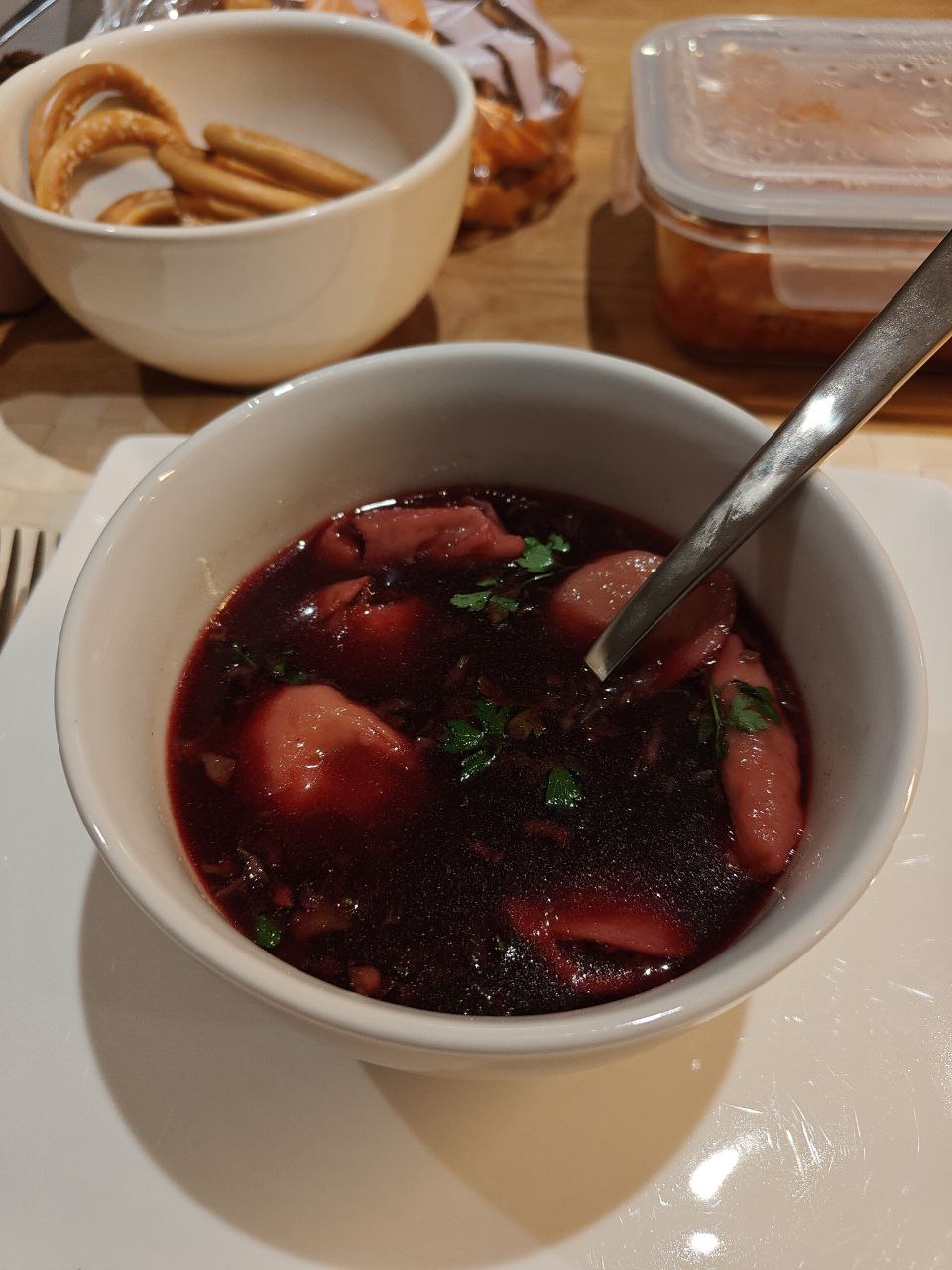
We see uszka dumplings floating inside the soup.
While I do not celebrate Christmas myself, I am sympathetic to friends who would rather spend these days in the comfort of emotional intimacy. An example of this is a new person I met last summer, who recently arrived in Amsterdam from Poland, and who somewhat unilaterally decided that we would be spending a few days together and that he would cook Polish dishes, in order to reproduce a tradition he had enjoyed in all his previous years.
Then, a few days before the fated dinner, he called me, despairing that his work shift would prevent him from spending enough time in his kitchen, and that he would need to sacrifice the most time-expensive recipe he had planned. He sounded very disappointed. Not keen to spend a day or two with him seething in a blue mood and also as an act of kindness and a small challenge to myself, I decided to go out of my way and try to arrange something. After a few calls to Polish friends and a visit to a special store a few towns over, I tasked myself with many hours in front of my stove.
The result was a very delicious barszcz: a very deep flavored mushroom and vegetable soup colored with marinated beets. Its taste was nearly as good as the smile on my friend’s face.
❦❦❦
The period that followed was a whirlwind. There were a number of very personal experiences, a few lucky encounters, a delightful visit of friends from abroad, some health scares (not mine, but still scary), some travel abroad and more trip planning. The calendar says one week, but my feelings say one month or even more!
Yesterday, I ended the period with a very long walk around Antwerp. That city has a lot to offer, including this funny wooden statue:

It’s supposed to be a Mary, but all I can see is a humorous drag queen.
❦❦❦
The month was so busy that I barely had time to read anything. The only bit of AI news that I felt was noteworthy was this article:
Evaluating Large Language Models in Scientific Discovery by Zhangde Song et al, in other words an astounding bunch of scientists across major research labs in the USA, Canada, Switzerland, China and the UK.
In a nutshell, the authors evaluated LLMs across the full loop of scientific discovery: hypothesis, experiment, observation, revision and back to hypothesis. They also evaluated them on tasks spanning multiple fields including biology, physics and chemistry.
What they found was… underwhelming. LLMs are good at proposing hypotheses, but disappointingly brittle at everything else. They overfit to patterns, they struggle to abandon bad hypotheses even in the face of contradictory evidence, they confuse correlation and causation, they hallucinate explanations when experiments fail, and they optimize for plausibility instead of truth.
More worryingly, high benchmark scores do not correlate with high scientific ability. The big, expensive models that were optimized to top reasoning tests can’t seem to run iterative experiments and update hypotheses.
The main takeaway: scientific intelligence is not language intelligence.
There is still a huge gap.
❦❦❦
Another lesson that gave me serious pause, and which I now find very important to share, is this video:
The author is a Russian person living in Estonia. He teaches us how modern propaganda really works. According to him, propaganda is not based on blatantly false words anymore, said very loudly, with censorship of contrary opinions. Instead, it’s using a cacophony of contradictory opinions to disable our interest in the truth, by overwhelming our attention. That feeling that you’d rather switch off the news on the TV/radio and instead play video games? That is what modern propaganda wants you to do.
I felt cold chills in my back when I understood what he was explaining. Back in March, I already started to feel that something was amiss, but I hadn’t envisioned back then that this could be the effects of active propaganda.
My current project to help folk claim their attention back feels even more important in this new light.
❦❦❦
It is snowing this week in the Netherlands so I am about to go on a walk and enjoy the sound of silence outdoors. The time to reflect on the entire year will also come soon, so expect a bit more from me before the next monthly update.
Until then, enjoy this intriguing instrument: