November Update
The vibe for November was more studious and activity-oriented. It was surprisingly hard to find a suitable illustrative visual, but I found this funny picture:
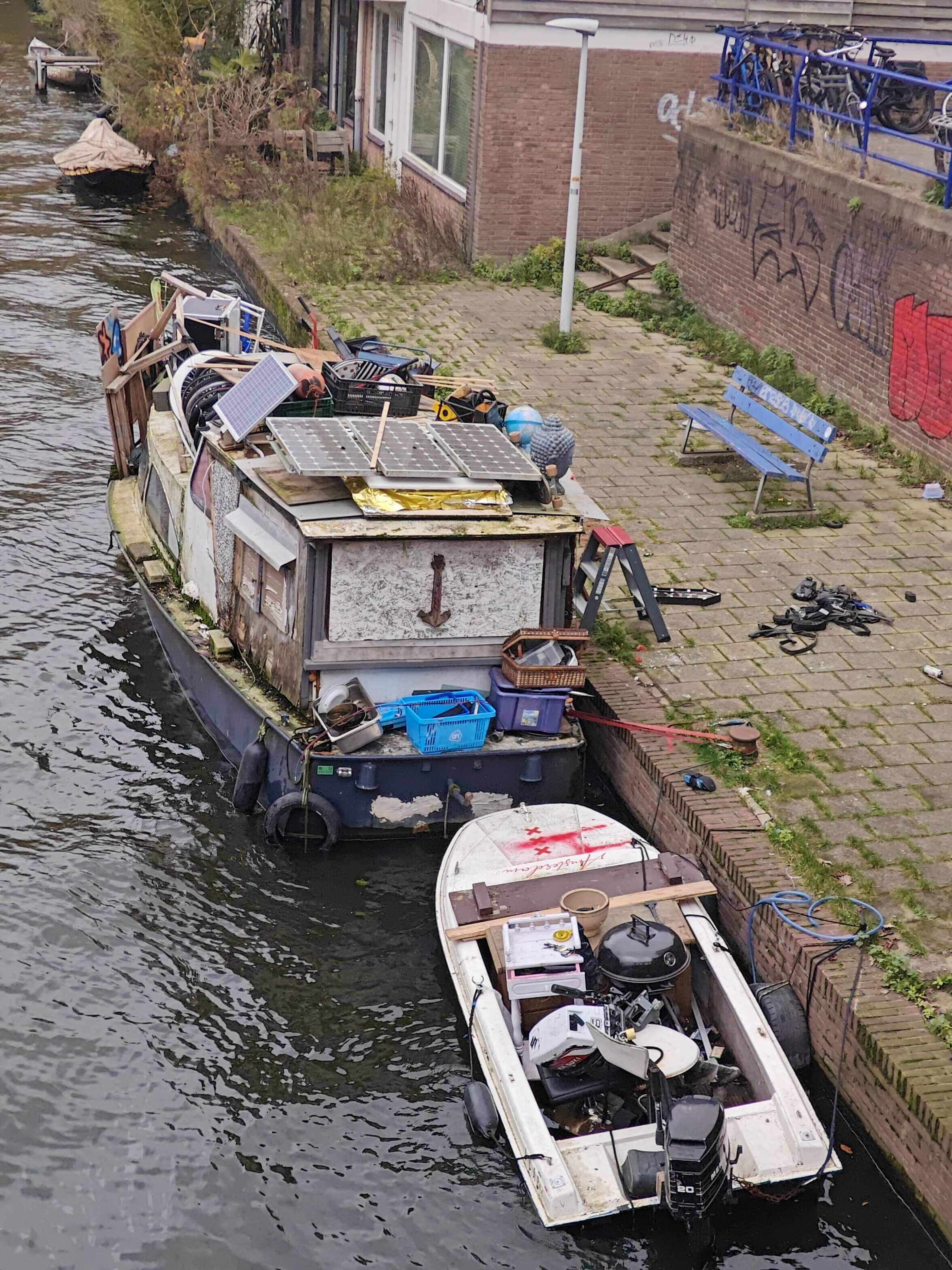
This is a shot from a city hike with a friend. It’s like a fractal: at a distance it does not look like much, but the more you look into it, the more you discover incongruous and surprising details.
I have a love and hate relationship with this picture. On the one hand, it’s a fun metaphor for the observation that that day-to-day life has a surprising amount of detail that’s often not visible to outsiders, nor remembered a few months later. On the other hand, that boat is messy and that’s not an accurate description of my life. Or is it? Hah.
❦❦❦
Anyway. So I also went again to visit my mom to do some paperwork. One of the lessons I’ve learned this month is that many adults are struggling with caring for an elderly parent but nearly nobody is talking about it. That sucks and I feel there is no good reason for this silence. Topically I am very grateful to all the friends who were willing to talk about it already.
Another thing I found surprising is how often my mind wanders back to the topic of taxes and government spending: we often hear rumbles in politics about how senior care is expensive and it was my turn to seriously consider this. (While in the Netherlands senior care is not part of the top 5 concerns, I understand it is in many other Western countries.)
I now have first-hand experience of how healthcare becomes more intensive with age, and how caring for a person is nearly a full time job. Of course these things are going to be expensive. But it is a trade-off! This care has to come from somewhere. If it were not for government-funded support structures, it is the families that would need to provide this care. The resources (time, money, emotional energy) allocated to this care would not be available to do other things. In many cases, professional experts can also provide better care than non-specialized (and sometimes resentful) family members. Moreover, depending on privately funded care structures mean even greater inequality in old age.
Also, what happens when the supporting family members start needing care too? One painful side effect of rising life expectancy without cure for degeneracy diseases is that a person can live while their body and/or mind does not function well anymore. A person can grow to ninety years old but fully dependent on care from age seventy, while their children get to retirement and start needing care of their own.
Truly, social security, retirement benefits and, foremost, structural, community-supported elderly care were some of the greatest achievements of humanity.
Here’s a question for you: what is your care plan? Like, not just how do you plan to care for your elderly parent; what is your plan for yourself? For when/if you become dependent? What do you want to happen if/when you are not able to make decisions yourself but you still get to live for years afterwards?
Remember, you won’t be able to “make plans” after you start needing them…
❦❦❦
On a completely different register, I was invited by a local magazine to collaborate on an article on thermal insulation for houses. In a nutshell, lately Dutch municipalities have been commissioning the publication of “guides” on how to improve your living space for sustainability; this year it’s my city’s turn, and through word of mouth I was selected as “showcase”. The journalist and I finalized the copy last week, and I am expecting photographers next week. Very curious about the outcome.
❦❦❦
On a tangentially related note, I spent an embarrassing amount of time last month studying solar panels and the electrical equipment around them, with an eye towards perhaps adopting a home battery later. It was fun! (I think it was the equivalent of what “normal” people like doing with cars.)
The challenge I was after was to discover the “meta” of this story. There are dozens of brands, hundreds of panel / inverter models to choose from, thousands of valid combinations, and information online is polluted by distributors and installers who distort facts trying to make money on a market with razor thin margins.
I started the month deeply annoyed by this apparent complexity, and ended much happier with somewhat of a clear picture. Here are some of the things I’ve learned:
The technology was pushed by market forces to standardize interfaces: nearly all inverters work with nearly all panels and all batteries. If the system is advertised as modular, you’re rarely stuck with proprietary protocols and can swap vendors / choose them independently. This was a huge relief. (Except with Enphase. They’re like Apple. Not cool.) The main technical choices that remain are peak per-panel power (Wp), inverter power capacity (kW), battery capacity (kWh).
DC circuits from panel to inverter have maximum efficiency on paper, but unless you have either a very homogeneous, large installation or a tiny home / caravan, AC coupling with micro-inverters next to the panels, AC to the meter, and a separate inverter for the battery(ies), with AC in-between, is always the best choice. (I wasted way too much time trying to figure out why. It turns out there are four different, reasons [1] and it’s much simpler to abstract away from them and ignore the details.)
That said, most battery inverters that charge from AC (including when panels are AC coupled) do not know how to charge if the grid is down, and that’s true even if they can power the home in that case. The result is that if the power goes down while it’s sunny, you drain your battery while wasting your solar energy.
To simplify, that’s because the charging circuit, where the panels and the grid are connected, is separate from the load circuit where the home is connected. When the grid is down, the entire charging circuit must disconnect for safety reasons.
The alternative here is called “island mode.” It is very common for caravan / RV setups, but only few home-sized inverters support it. They are also somewhat more expensive.
People know their yearly energy usage (typically, in MWh) but panels are rated as “Watt-peak” (Wp), a unit of power. What is the relationship between them, and how would you use this information to size a system?
For this, you need your geographical yield factor: how many kWh per year you can effectively expect given the installed panel/inverter kW. It depends on geographical location / climate and panel orientation. For example for my location and typical roof setup around here, it’s about 885, in Spain it would be about 1200, in Australia/Texas 1500. Take your yearly energy usage, divide by the yield factor, and that gives you the maximum amount of solar power you “need” — exceed that and you’ll need to get rid of some of that energy somehow [2].
If you think you can use all your solar energy (either through batteries, or because your grid provider substracts it from your consumption), adding panels up to that maximum will typically pay off before the expected lifetime of the panels and generate money afterwards; i.e. it’s an investment.
For batteries, you need your average daily energy usage (in kWh) and your peak power usage (in kW). You’ll try to match battery capacity to the first number (batteries don’t hold charge for more than a day or two) and the inverter power capacity to the second number. If you are only seeking energy independence from the grid, e.g. to protect yourself from occasional blackouts, that’s all you need.
However, if you also want the money math to work, it’s more complicated. Batteries and inverters are still somewhat expensive. Smaller batteries are cheaper, but then they have more frequent charge/discharge cycles so their lifetime is shorter. I have not figured out that part yet. The money math works better when you instead spend money to reduce your energy usage indoors, and shift it to the hours of peak solar production.
Another approach that might work better is using an electric car as home battery (V2H).
I am expecting my new panel setup, together with more pictures, in January.
| [1] | Energy loss on long connecting cables; less danger of fire in case of circuit faults; more MPPT circuits needed for heterogeneous orientations / exposures; more products on the market and so generally lower prices. |
| [2] | Owners often limit their solar size based on their own energy usage; I am personally optimistic that the time will come where communities will size solar together, to include the needs of folk who live in apartments or narrow, high houses. |
❦❦❦
November was also when I first started to attend a few political events in connection to my city council. For context, before last summer I became a member of the political party I was voting for for the last ten years. My motivation arose from the realization that politicians (at least, at the local level) are just everyday people who take action for their community, that I wanted to have people like that in my social circle, and so logically the next step was to get connected to them somehow. Since then, I have also volunteered to become a supporter during the next council election.
Week-to-week, this new occupation has not impacted my life yet; there is just one event per month or less, and the more regular meetings are only to discuss current affairs—of which there are only few in my small town. One more visible change is becoming a member to numerous online discussion groups, where many members with an idler life than mine spend a lot of time animating lively conversations with very little depth. These are harder to follow, and it might take me a while before I identify areas where I can make a difference. Nonetheless, participation starts with showing up. That much, I can do.
❦❦❦
On the health front, my right shoulder is doing slightly better, to the point I was able to restart using it for resistance training. However, there is a high risk of regression and it is annoying to balance: remaining under my max load while increasing the load to regain my strength.
I also obtained both a flu shot and COVID booster, with the hope to reduce downtime during my upcoming travel in January and February. Sadly, this does nothing against rhinoviruses, of which I caught two separate variants in short succession. I was down for three weeks and only restarted my full routine a few days ago.
❦❦❦
On the work front, obviously the ongoing topic of my mom’s health continues to tax my time and energy (and sleep quality); three weeks of illness on top of that meant the work month was very short.
There was some good news and some bad news.
The good news is that I hammered out a plan with my accountant, who also chips in occasionally as my fiscal and legal watchdog, to structure my runway in a way that will save me some money. Part of that plan included incorporating my project, so I officially registered a new business. It should feel like a big thing, but really to me it did not feel like it was—I filled a form online, paid some fees, and that was all—so I guess it wasn’t? (Or maybe, the Netherlands is just a very good place to create and close businesses. Did you know that modern corporations were invented in Holland?)
This was also the right moment to execute an elaborate stack of paperwork to properly transfer the ownership of the technology I built in the last six months, into the new entity. I learned way more than I care to admit about the Dutch legal frameworks around intellectual property, corporate contracts, and transfer pricing! (Generally, regulation on transfer pricing is only relevant to large, multi-national businesses, but these big laws targeting large companies also happen to determine how to properly calculate the price of intellectual property when drawing paperwork like mine.)
I also enjoyed it! Legal work feels a bit like programming computers, except that you’re programming processes that involve people instead. It makes it way more interesting (and challenging). I already had experience in an adjacent area from years ago, and it was very fun to see these skills transfer while learning what I needed to know.
The bad news is that I was also hoping to hire a brilliant person I met earlier this year to assist me with project planning and organization—to keep focus week-to-week, given how many things I deal with simultaneously—and that person found a better opportunity just as we were about to draw the paperwork. So I’ll need to continue improving my organization skills alone for the time being.
❦❦❦
On the reading front, I had two very strange experiences.
First, there’s this book I learned about two months ago, which I really wanted to read because of its glowing recommendations. I started reading it, and I had to agree it is very good, but it’s also a more condensed version of many things I knew already / learned from other books before (and life experience). So I forced myself to continue reading it for… no good reason really? The entire time, I was telling myself “I want to read this, it’s well written, I want to be able to say I read it afterwards” but my eyes were glazing over the pages and I needed to re-read chapters multiple times before I could move on. I was so bored!
And it pains me to write about it this way, because it is really a good book and I do want to recommend reading it to friends! Anyway…
- The Happiness Hypothesis: Finding Modern Truth in Ancient Wisdom by Jonathan Haidt
In a nutshell, this book cross-references modern results in psychology, anthropology and sociology, with folk wisdom and historical references, in search of a deeper understanding of the various things that make people more happy.
Again, I will re-state that this book is very good. It does an excellent job at what it’s set to do, and the arguments are strong. The author spells out grounded ideas about why people do what they do, and what we need to do to overcome to balance the slog of existence with a more content mindset.
I would likely recommend this book in two situations. One would be as an introductory read for a young person who does not have a philosophical education yet. The other case would be to a person of any age who feels a bit overwhelmed by the noise of modern life, and wants to regain some mental and emotional (and spiritual) clarity.
I was so tired of reading after I powered through the above that I was not ready to advance my planned reading list, so I picked up something random next. And ooooh boy! That one was a doozy.
- Radical Honesty : How to Transform Your Life by Telling the Truth by Brad Blanton
Overall, this book is about the author’s experience as a therapist and his recollection of techniques that he has used that have worked with his patients. That said, the framing he uses is that there is a central theme to his techniques: telling the truth in every situation. (Hence the title)
The reason why I felt strange while reading this is that on the one hand I cannot deny that he has obtained results with his patients and I even recognize some of the techniques that he has used as being very valid and useful. On the other hand the justification he uses for many of his situations is complete b.s.!
However, I cannot be mad because he also says so in the beginning of the book. Like, literally, his introduction is all about the publisher sayings the book was b.s., the author agreeing and then deciding to publish it anyway.
Thus, every chapter, I was starting to read with the mindset “what is the interesting thing that is happening here and what is the b.s. excuse he is going to use to explain it.”
This dynamic reminds me of the character Rincewind in the Discworld series from Terry Pratchett. That character is a wizard who is a coward and kinda stupid but also very good at experiencing stuff and doing very interesting things through which we learn a lot about his world and a lot about philosophy.
❦❦❦
On the topic of AI science, I found two very serious bits that made me chuckle.
In Adversarial Poetry as a Universal Single-Turn Jailbreak Mechanism in Large Language Models, the authors Piercosma Bisconti et al. teach us that you can use poetry to work around the censorship baked into system prompts.
Meanwhile, Udari Madhushani Sehwag et al. from ScaleAI published a new benchmark called PropensityBench; in its introductory article, they explain that the benchmark reveals how most current LLMs have a tendency to take major ethical shortcuts (i.e. they do more bad things) when given an input that suggests they are under pressure to perform, e.g. when under tight deadline or high penalty for failure.
❦❦❦
Shifting gears. I loved reading this study: Optimism is associated with exceptional longevity in 2 epidemiologic cohorts of men and women by Lewina O. Lee et al.. As the title suggests, after other factors are factored in, optimism alone seems to incur a 15% additional lifespan for both men and women.
❦❦❦
I also loved this analysis made by the animation artist Marik ‘Mik’ Roeder:
In this 15-min video, the artist explains how there is currently a movement to fragment the LGBT community into factions that oppose each other. They also point out that this happened before with feminism. They also point out that this is part of a well-documented, public plan by conservative thought leaders to reduce the influence of queer people in politics (a literal use of “divide and conquer”). The call to action, of course, is to unite in action despite differences in life directions.
❦❦❦
Also, in a scientific report that surprises absolutely no-one, we now have hard evidence that banning cell phone use in schools results in better education outcomes. See The Impact of Cellphone Bans in Schools on Student Outcomes: Evidence from Florida by David N. Figlio & Umut Özek.
❦❦❦
Finally, the thing that I wish you will appreciate as much as I did is this article by Adam Mastroianni: Why aren’t smart people happier?.
In this delightful writeup, the author explores why it seems that on the one hand, “intelligence” seems to correlate across many domains (i.e. a good result on a test in one area is predictive of good results in many other areas), yet on the other hand we have ample evidence that intelligence and happiness do not correlate at all.
The main contribution of the article is a new theory: that the “intelligence” we often reward (the one related to IQ, scientific skills etc) corresponds to a higher ability to solve well-defined problems; whereas “how to be happy” (and incidentally, “how to be good parent” and “how to be a good person,” also named in the article) are questions of a different kind, that the author calls poorly-defined problems, and the theory is that these are independent skills. People who are good at the one kind of intelligence are not necessarily good at the other (and vice versa).
Incidentally, the author also laments our social norms, where we over-celebrate people good at well-defined problems (professors, doctors, high-IQ society members) and under-celebrate people skilled at poorly defined life problems. For example, his grandmother can’t operate the TV input button but is excellent at raising a loving family, enduring tragedy, and making meaningful traditions: classic poorly defined problem-solving.
Because there’s no test or number for this kind of intelligence, society often dismisses it as “folksy” rather than treating it as a core form of human competence. Ignoring and undervaluing this ability leads us to overuse smart-but-narrow problem-solving where we actually need wisdom, leaving us successful on paper but unsatisfied in life. (There is also a bit in there about our current AI systems being over-optimized in one direction, but I don’t think it’s the main point.)
His closing advice: seek out wise people (like your grandma), listen, and maybe help them with their tech afterwards.
Which also raises a question on my side: what kind of person do I want to become?